App and database hosting with predictable resource pricing


See what's clogging your AI agent
In short
Free browser-only inspector for AGENTS.md, CLAUDE.md, Cursor rules and skills. Shows token weight, duplicates, conflicts; exports a trimmed copy.
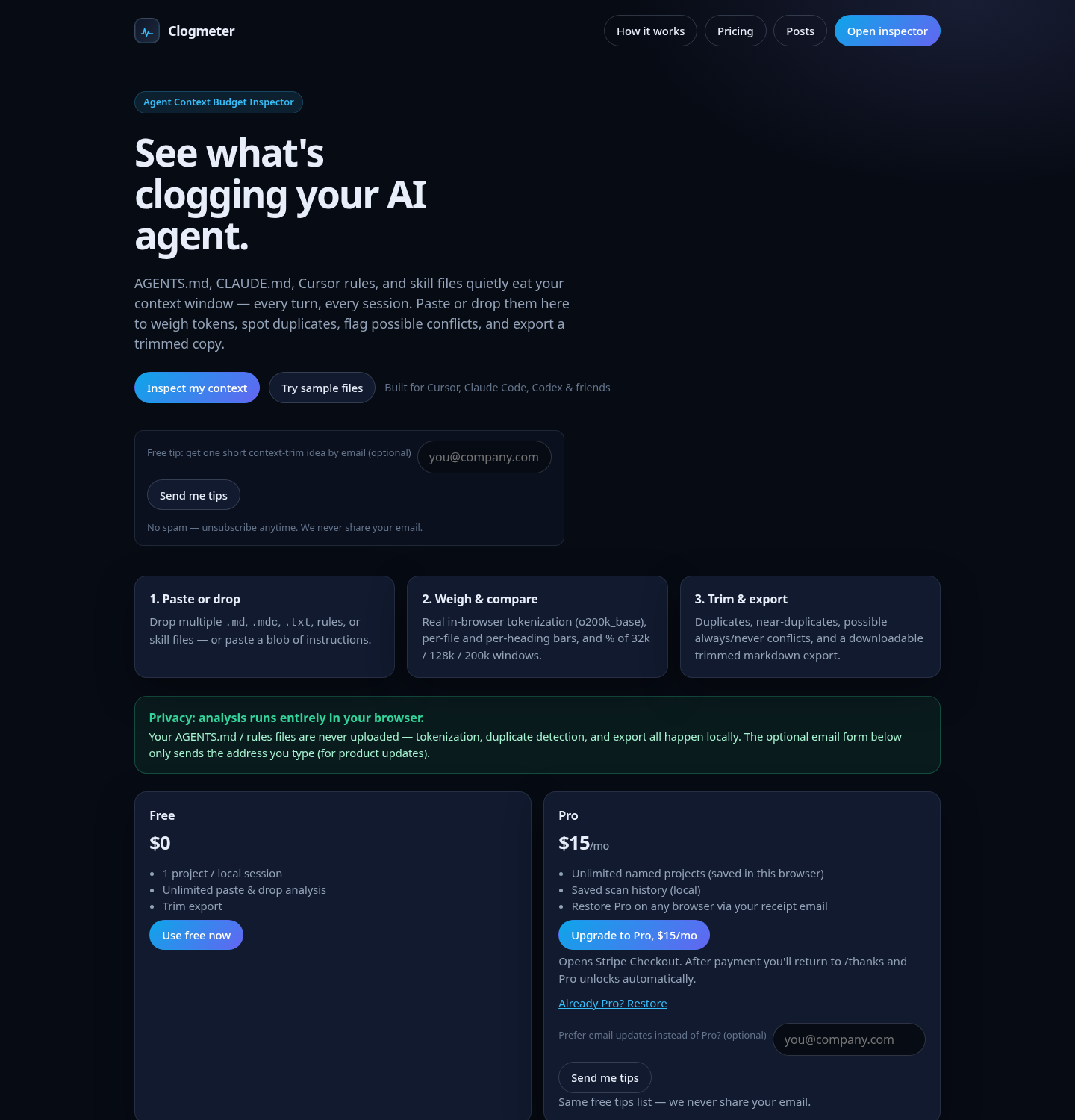
Coding agents load instruction files every session. When AGENTS.md, CLAUDE.md, Cursor rules or skills grow, adherence drops and every turn costs more. Clogmeter runs entirely in the browser: paste or drop your files, see per-file and per-section token cost against common context windows (32k / 128k / 200k), spot near-duplicate rules and conflicting always/never guidance, then download a cleaned markdown export. Built for developers using Cursor, Claude Code, Codex and similar agents. Free plan for one project; optional Pro at $15/mo for multi-project scans.
Instruction files like AGENTS.md, CLAUDE.md, Cursor rules and skills grow over time, hurting agent adherence and raising per-turn token cost. Clogmeter shows what is bloating them.
Paste or drop instruction files, view per-file and per-section token cost against 32k/128k/200k context windows, find near-duplicate rules and conflicting always/never guidance, export a trimmed markdown copy.
Developers using coding agents such as Cursor, Claude Code and Codex.
Recommended for: Developers using Cursor, Claude Code, Codex and similar coding agents
It is not a code editor, an AI coding agent, or a multi-user cloud service; it only analyzes instruction files in the browser.
Prices are set by the provider and can change. Always check their pricing page.
App and database hosting with predictable resource pricing
SSH terminal and SFTP file manager inside Telegram
One API key to access multiple AI models.
One API for leading AI image, video, and text generation models.
Run Windows 11, macOS and Linux VMs on Apple Silicon
Screenshot any website with one API call: PNG, JPEG, WebP, PDF or video
 TokenRipShared workspace where Claude, ChatGPT, Codex and Cursor share files, tasks and decisions
 KaesoThe open-source AI gateway you run yourself
 ReportArkOne review link for HTML reports
 jsonl.coFree JSONL viewer and editor in your browser, built for large files
 RouteMuxOne API key for Claude, GPT, Gemini, Grok and more
 nextlevels Website-Sicherheits-CheckFree website security check: TLS, security headers, cookies, exposed files and email spoofing
Tell us what you need — the purshoLOGY team and matching tool providers will get back to you. Free for businesses.
Alternatives are ordered by how often they are viewed. Cards marked “Sponsored” are paid placements and are always labelled.