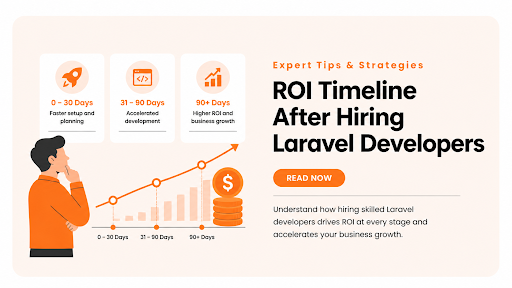
One of the most common questions businesses ask before they hire Laravel developers is a very reasonable one: when does this start paying for itself?
The honest answer is that ROI from hiring a Laravel developer is not immediate. In the first two months, you are paying for a developer who is learning your codebase, building product context, and working up to full velocity. That is the expected pattern of any professional relationship that requires depth before delivering full value. Understanding this timeline upfront helps you set realistic expectations and avoid making a reactive decision to end an engagement before it has reached its productive phase.
This guide maps the ROI timeline month by month for a typical dedicated Laravel developer engagement, explains what drives ROI at each stage, and gives you a framework for measuring return on investment in your specific business context. If you are still deciding whether to Hire Laravel Developers, consider evaluating your project requirements, timelines, and long-term scalability needs first.

What Does the ROI Timeline Actually Look Like Month by Month?
Every dedicated developer engagement goes through four distinct phases. Understanding what happens in each one helps you interpret what you are seeing and make better decisions about the engagement.
Months 1 to 2: The Investment Phase
In the first two months, the developer is building the context they need to deliver at full velocity. They are learning the codebase, understanding the business domain, establishing communication patterns, and completing initial setup and architecture work. This work is essential but it does not immediately translate into user-visible features.
During this phase, the direct value delivered in features shipped is typically around 40 to 60 percent of the monthly developer cost. This is not a warning sign. It is the expected ramp-up curve of any professional engagement that requires context before delivering full value. The investment made in months one and two is what makes months three through twelve possible.
The single most effective thing you can do to shorten this phase is to invest in onboarding. A developer who receives a codebase overview document, a tested environment setup guide, a domain glossary, and a clear first-sprint task list on day one reaches productive velocity in six to eight weeks instead of twelve. That four-week acceleration directly advances your break-even point.
Months 3 to 4: The Break-Even Phase
Between months three and four, most dedicated Laravel developers reach delivery velocity where the value of their output equals or exceeds their monthly cost. This is the break-even point for the engagement, and it arrives earlier when onboarding is good and requirements are clear.
At break-even, the developer is completing features faster because they understand the codebase. They are catching problems earlier because they know where the fragile parts are. And they are contributing to decisions with genuine product context rather than making educated guesses about how things work.
Businesses that see break-even arrive later than month four should look at three things first: the quality of onboarding provided, the stability and clarity of requirements, and whether the developer’s seniority matches the complexity of the work. All three factors directly influence how quickly a developer reaches productive velocity.
Months 5 to 12: The ROI Compounding Phase
From month five onwards, accumulated product knowledge begins to compound in a way that is genuinely visible in delivery output. The developer completes familiar types of tasks significantly faster than they did in month one. They identify potential problems before they become expensive. They contribute to architectural discussions with real product context. And they make fewer mistakes because they understand why the system works the way it does.
The monthly value delivered exceeds the monthly cost by a growing margin during this phase. This is where the ROI from a dedicated engagement becomes clearly superior to the alternatives. A rotating freelancer never reaches this phase. An agency developer shared across multiple projects reaches it much more slowly, if at all.
Month 12 and Beyond: The Product Asset Phase
A dedicated developer who has been on your product for twelve months is a product asset, not just a development resource. Their knowledge of why the codebase is structured the way it is, what has been tried and abandoned, and how the business actually uses the software is genuinely irreplaceable. This knowledge has commercial value that goes well beyond their monthly delivery output.
Losing a developer at this stage is more expensive than most businesses realise, not just because of the replacement and ramp-up cost, but because of the accumulated knowledge that cannot easily be transferred in a handover document. This is one of the strongest arguments for building a long-term relationship with a developer through a partner who provides replacement guarantees and structured knowledge documentation as standard.
How Does ROI Vary by Business Type?
The speed at which a Laravel developer generates ROI depends significantly on the type of product they are working on. Different business models have different primary value drivers, and the timeline to realising that value varies accordingly.
SaaS Products
For SaaS (Software as a Service) products, the primary ROI driver is feature delivery that acquires and retains subscribers. The developer’s output translates to MRR (Monthly Recurring Revenue) growth through new features that attract customers, and to churn reduction through bug fixes and stability improvements that keep them. Break-even typically arrives between months three and five, depending on the product’s complexity and the feature pipeline’s clarity.
The right way to measure ROI for a SaaS product is to track MRR changes attributable to specific feature releases and to compare subscriber churn rates before and after stability improvements delivered by the developer. Both measures connect developer output directly to business revenue in a way that makes ROI calculation straightforward.
E-commerce Platforms
For e-commerce businesses, ROI drivers are conversion rate improvements and new revenue features. A developer who optimises the checkout flow, reduces page load times, or adds a feature that increases average order value generates measurable revenue impact that is directly attributable to their work. Break-even for e-commerce engagements typically arrives between months two and four because the revenue impact of improvements is immediately measurable.
Measure ROI by tracking revenue per session, cart abandonment rate, and average order value before and after specific developer deliveries. E-commerce metrics are some of the cleanest for ROI measurement because the connection between development work and business outcome is short and direct.
Internal Business Tools
For internal tools, the primary ROI driver is staff time saved and process error reduction. A developer who automates a manual process that five employees spend two hours on every day delivers 50 hours per week of staff capacity back to the business. At any reasonable staff cost, that ROI is significant and arrives quickly.
Internal tool engagements often have the fastest ROI timeline of any business type, with break-even arriving as early as months one to three. The challenge is measurement: you need to track hours spent on the automated process before and after, and error rates in the process before and after. These baselines are often not captured before development begins, which makes retrospective ROI measurement harder than it needs to be.
Enterprise Platforms
Enterprise engagements have a longer ROI timeline because the value is often in technical debt reduction, compliance enablement, and maintenance cost reduction rather than in immediate revenue features. Break-even typically arrives between months four and six, but the ROI from months six to twelve tends to be substantial because the compounding savings from reduced maintenance overhead and prevented incidents are large.
Measure enterprise ROI by tracking incident rates and their resolution costs before and after, maintenance time per sprint, and any compliance certifications or contractual requirements unlocked by the developer’s work.
What Causes ROI to Arrive Later Than Expected?
Several factors consistently delay ROI beyond the typical timeline. Understanding them in advance lets you address them before they affect your engagement.
Poor Onboarding
A developer who takes three months to become productive instead of six weeks pushes break-even to month five or six. The fix is straightforward: invest in onboarding documentation before the developer starts. A codebase architecture overview, a tested environment setup guide, a domain glossary, and a structured first-sprint task list all directly shorten the ramp-up period. This is a one-time investment that pays for itself within the first month.
Unclear or Unstable Requirements
A developer who rebuilds features repeatedly because requirements change mid-sprint delivers far less net value per month than one working from stable, well-specified tasks. Sprint planning discipline and backlog grooming, where the next sprint’s tasks are defined and estimated before the current sprint ends, are the most effective defence against requirements instability.
Wrong Seniority Level
Hiring a junior developer for a project that requires mid-level or senior judgment delays ROI by months compared to hiring at the appropriate level. A junior developer on a complex codebase makes architectural decisions that require later correction, generates more rework, and takes significantly longer to reach productive velocity. The rate premium for a senior developer is almost always recovered in time savings within the first quarter. Matching seniority to complexity is one of the most important decisions in the entire Laravel developer hiring process.
Inadequate Technical Leadership
A developer without architectural guidance makes decisions that seem reasonable in isolation but require correction as the product grows. If the developer is not senior enough to provide their own architectural oversight, someone with that capability needs to be available to them. This might be a technical lead within your organisation, a senior developer who reviews their work, or an engagement structure that includes architectural support from the partner.
Outcome-Based Management vs Micromanagement
Developers who are over-managed spend disproportionate time on status reporting, check-ins, and clarification conversations instead of productive development. Managing outcomes, which means defining what needs to be delivered and measuring delivery, rather than managing by activity produces significantly more productive development hours per month. It also produces better developer wellbeing and retention, which matters in a long-term engagement.
What Metrics Should You Track to Measure ROI?
Measuring ROI from a Laravel developer engagement requires connecting their output to business outcomes. The specific metrics depend on your business type, but the principles are consistent.
Start by establishing baselines before the developer starts. Track current feature delivery rate, current bug rate, current performance metrics for your key user flows, and any business metrics directly linked to development output like MRR, conversion rate, or support ticket volume. Without baselines, you cannot measure change.
- Sprint velocity: story points or tasks completed per sprint, tracked from sprint two onwards and expected to trend upward through month six
- Defect rate: bugs reported per sprint in production, which should trend downward as the developer builds familiarity with the codebase
- PR (Pull Request) first-pass approval rate: the percentage of code reviews approved on first submission, which reflects code quality discipline
- Time to feature delivery: how long specific feature types take to complete, which should decrease as domain knowledge accumulates
- Business outcome metric: whichever metric in your business is most directly linked to development output, tracked monthly against pre-engagement baseline
Review these metrics monthly and use them to have an honest conversation with the developer and your partner about whether the engagement is tracking as expected. At Acquaint Softtech, our account managers review engagement metrics with clients monthly and flag any patterns that suggest the timeline is diverging from the expected trajectory.
How Does Acquaint Softtech Help You Maximise ROI?
At Acquaint Softtech, we do not just place a developer and step back. We work with you to map expected ROI against your specific business type and development goals before the engagement starts. Our account managers help you establish the baselines, define the metrics, and structure the first sprint in a way that minimises ramp-up time and accelerates break-even.
Every Acquaint Softtech engagement includes structured onboarding support, a named account manager who reviews engagement health monthly, and a replacement guarantee with a defined timeline. If a developer is not tracking against the expected ROI curve for reasons within our control, we address it. If a replacement is needed, we handle it within days rather than restarting the search from scratch.
As an Official Laravel Partner, Acquaint Softtech assesses every developer against domain-specific technical criteria, not just general framework knowledge. A developer placed on a SaaS product has been assessed on multi-tenancy, subscription billing, and API design. A developer placed on an e-commerce platform has been assessed on checkout performance and payment gateway integration. Domain match directly accelerates ramp-up and moves break-even earlier.
You can explore the full range of our Laravel development services or get in touch directly. We can have matched, technically assessed candidates in front of you within five business days of a discovery conversation.
Final Thoughts
The ROI timeline after hiring a Laravel developer follows a predictable pattern when the engagement is structured well. An investment phase in months one and two. Break-even between months three and four. Compounding returns from month five through twelve. And a product asset that delivers returns well beyond their monthly cost from month twelve onwards.
The businesses that get the most from this model are the ones who understand the timeline before they start, invest in the onboarding and requirements quality that accelerates it, and measure the right metrics to confirm it is tracking as expected.
A dedicated Laravel developer is not an expense that starts paying for itself eventually. It is an investment with a predictable return curve that you can plan around from day one.
If you want to understand the full picture before you commit, take time to evaluate your current development bottlenecks, long-term product roadmap, and the level of expertise required to scale efficiently. Comparing different hiring models, such as freelancers, in-house teams, and dedicated developers, can also help you make a more informed choice.
When you are ready to move forward, the Acquaint Softtech team is ready to help.
Frequently Asked Questions
When does a Laravel developer start paying for themselves?
For most dedicated Laravel developer engagements, the break-even point, where the value of output equals the monthly cost, arrives between months three and four. This varies based on onboarding quality, requirements clarity, and developer seniority match. Engagements with excellent onboarding and clear requirements sometimes reach break-even in month two. Engagements with poor onboarding and unclear requirements sometimes take until month five or six.
What is the ROI of a senior developer versus a junior one?
A senior developer has a higher monthly rate but typically reaches break-even faster and delivers a higher ROI margin from month five onwards because they generate less rework, make better architectural decisions, and reach productive velocity sooner. For complex projects, the rate difference between a senior and junior developer is usually recovered in time savings within the first quarter. Hiring at the wrong seniority level is one of the most common and most expensive mistakes in Laravel hiring.
How do I calculate ROI for an internal tool developer?
Track hours spent on the process being automated before development starts and after delivery. Multiply the hours saved per week by the fully loaded cost of the staff who were doing the work manually. That weekly saving, annualised, is the direct financial ROI of the feature. Add to it the value of error reduction if the manual process had a measurable error rate. Internal tool ROI is often the simplest to calculate and the fastest to arrive.
What should I do if ROI is not arriving on the expected timeline?
First, diagnose the cause before making a decision. Is the developer not meeting velocity targets, or are the velocity targets being met but not translating to business outcomes? If it is a velocity problem, look at onboarding quality, requirements clarity, and whether the seniority level matches the work. If it is a translation problem, look at whether the features being delivered are the right ones for the business metrics you are tracking. Contact your partner account manager with specific data. At Acquaint Softtech, engagement health reviews are designed to catch these patterns early and address them before they become significant.
Does the type of project affect how quickly ROI arrives?
Yes, significantly. Internal tool projects have the fastest ROI timelines because the value of automation and time saving is immediately measurable. E-commerce projects have fast timelines because conversion rate and revenue per session are directly trackable. SaaS projects take slightly longer because feature impact on MRR takes time to manifest in subscriber behaviour. Enterprise projects have the longest timelines but often the highest absolute ROI because technical debt reduction and incident prevention have large financial consequences at scale.
Is a dedicated developer a better ROI than a project agency?
For ongoing product development, yes, in almost every case. A project agency charges a margin on top of developer cost, introduces a communication layer that slows delivery, and provides developers who are shared across multiple clients and never reach full product knowledge. A dedicated developer has a lower effective cost once the margin layer is removed, reaches higher productive velocity because of full-time focus, and compounds in value over time in a way that project agency relationships structurally cannot. The dedicated model becomes clearly superior to the agency model at around month four of a comparable engagement.
| About the Author
Acquaint Softtech Acquaint Softtech is an Official Laravel Partner with over 15 years of experience delivering Laravel development services to SaaS, FinTech, e-commerce, and enterprise businesses across the US, UK, and Australia. With 70+ in-house engineers, a 5-star rating on Clutch, and 1,200+ successful client engagements, Acquaint Softtech helps product businesses hire Laravel developers and realise measurable ROI from every engagement. Areas: Laravel Development Services | Dedicated Developer Teams | Staff Augmentation | SaaS and FinTech | AI Development |