TL;DR:
Many ecommerce sellers obsess over product sourcing, advertising costs, and shipping rates while ignoring a major profit killer: packaging. A seemingly harmless ₹7 box can significantly reduce profits on a ₹99 product once tape, labels, inserts, handling, and shipping weight are factored in. If you’re selling low-ticket products, packaging costs can silently consume a large percentage of your margin and make scaling far more difficult than expected.
The Packaging Cost Trap Most Ecommerce Sellers Miss
When evaluating product profitability, most sellers focus on three numbers:

- Product cost
- Selling price
- Advertising cost
Packaging is often treated as a minor operational expense.
After all, what’s the big deal about spending ₹7 on a box?
The answer is simple:
On low-ticket products, every rupee matters.
A ₹7 packaging cost on a ₹99 item doesn’t seem significant until you realize it’s only the beginning of the packaging expense chain.
For thousands of ecommerce businesses, packaging quietly becomes one of the largest hidden costs impacting profit margins.
The ₹99 Product Profitability Myth
Let’s look at a common example.
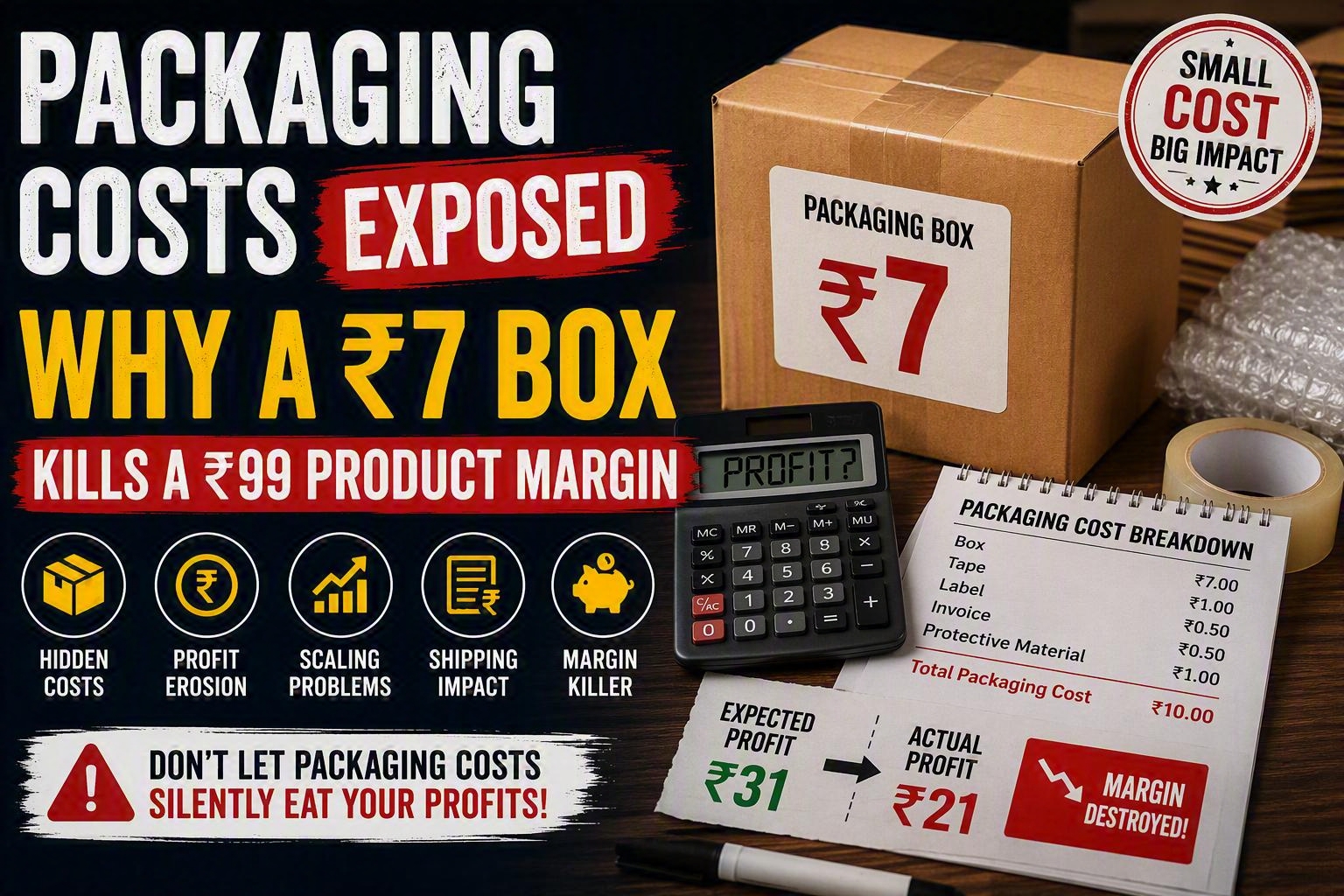
Product Economics
- Selling Price: ₹99
- Product Cost: ₹35
- Payment Gateway Fee: ₹3
- Marketplace/Ecommerce Fee: ₹10
- Advertising Cost: ₹20
Expected profit:
₹99 – ₹35 – ₹3 – ₹10 – ₹20 = ₹31
Looks profitable, right?
Now let’s include packaging.
Packaging Costs
- Corrugated Box: ₹7
- Tape: ₹1
- Shipping Label: ₹0.50
- Invoice Print: ₹0.50
- Protective Material: ₹1
Total packaging expense:
₹10
Revised profit:
₹31 – ₹10 = ₹21
One-third of the expected profit disappears immediately.
The Box Is Never Just a Box
Many sellers only account for the box price itself.
In reality, packaging includes multiple components:
Primary Packaging
- Product wrapping
- Pouches
- Protective sleeves
- Branding stickers
Secondary Packaging
- Corrugated boxes
- Courier bags
- Bubble wrap
- Air cushions
Branding Materials
- Thank-you cards
- Inserts
- Promotional flyers
- QR codes
Operational Costs
- Packing labor
- Packing stations
- Materials storage
- Printing expenses
The actual packaging cost is often much higher than expected.
Packaging Impacts Shipping Costs Too
A larger package doesn’t just cost more to purchase.
It often costs more to ship.
Courier companies frequently use:
- Actual weight
- Volumetric weight
When packaging increases package dimensions, shipping charges often increase as well.
For example:
A product weighing 250 grams may be billed as a 500-gram shipment simply because the box is oversized.
That means packaging costs can increase logistics costs simultaneously.
Low-Ticket Products Face the Biggest Risk
High-ticket products can absorb packaging expenses more easily.
Consider these examples:
Product A
- Selling Price: ₹99
- Packaging Cost: ₹10
Packaging consumes:
10.1% of revenue
Product B
- Selling Price: ₹1,999
- Packaging Cost: ₹20
Packaging consumes:
1% of revenue
The lower the selling price, the larger the relative impact of packaging costs.
This is why many low-ticket ecommerce businesses struggle despite healthy order volumes.
Premium Packaging Can Become a Profit Disaster
Many brands invest heavily in expensive packaging to improve customer experience.
This often includes:
- Custom-printed boxes
- Branded tissue paper
- Foam inserts
- Premium stickers
- Multiple printed inserts
While visually appealing, premium packaging isn’t always profitable.
Customers may appreciate it, but appreciation doesn’t automatically increase customer lifetime value.
If premium packaging isn’t generating repeat purchases or higher average order values, it may simply be reducing margins.
Returns Make Packaging Even More Expensive
Returned orders create a second layer of cost.
When a customer returns a product:
- Original packaging is often damaged
- New packaging may be required
- Additional packing labor is needed
- Restocking expenses increase
For low-margin products, even a modest return rate can significantly increase total packaging expenditure.
Why Fast-Growing Brands Obsess Over Packaging Efficiency
Successful ecommerce operators constantly optimize packaging.
Instead of asking:
“What looks best?”
They ask:
“What protects the product at the lowest possible cost?”
Their focus includes:
- Right-sized packaging
- Reduced void fill
- Lower package weight
- Bulk supplier discounts
- Simplified packing processes
The result is higher profitability without increasing sales.
How to Reduce Packaging Costs Without Hurting Customer Experience
Use Right-Sized Boxes
Avoid oversized packaging that increases material and shipping costs.
Negotiate Bulk Pricing
Purchasing packaging materials in volume often unlocks substantial savings.
Eliminate Unnecessary Inserts
Only include inserts that provide measurable marketing value.
Standardize Packaging Sizes
Fewer box sizes simplify operations and reduce inventory complexity.
Monitor Packaging Cost Per Order
Track packaging expenses as carefully as advertising and shipping costs.
Test Alternatives
Courier bags, recyclable packaging, and lightweight materials may offer significant savings.
The Hidden Scaling Problem
Many businesses ignore packaging while processing a few hundred orders per month.
But scale changes everything.
Consider this scenario:
- 10,000 monthly orders
- Extra packaging cost: ₹5 per order
Monthly impact:
₹50,000
Annual impact:
₹6,00,000
A small inefficiency becomes a major expense as order volume grows.
Final Thoughts
The biggest mistake ecommerce sellers make is viewing packaging as a minor operational detail. For low-ticket products, packaging can consume a surprisingly large percentage of revenue and dramatically reduce profitability. A ₹7 box may seem insignificant, but once additional materials, labor, and shipping implications are included, it can become one of the largest hidden costs in the business.
The most profitable ecommerce brands don’t just optimize products and ads. They optimize every rupee spent on fulfillment, including packaging.
Ready to Protect Your Margins?
Audit your packaging costs today. Calculate the true cost per order, identify unnecessary expenses, and optimize your fulfillment process. The difference between a struggling ecommerce business and a profitable one may be hiding inside the box.