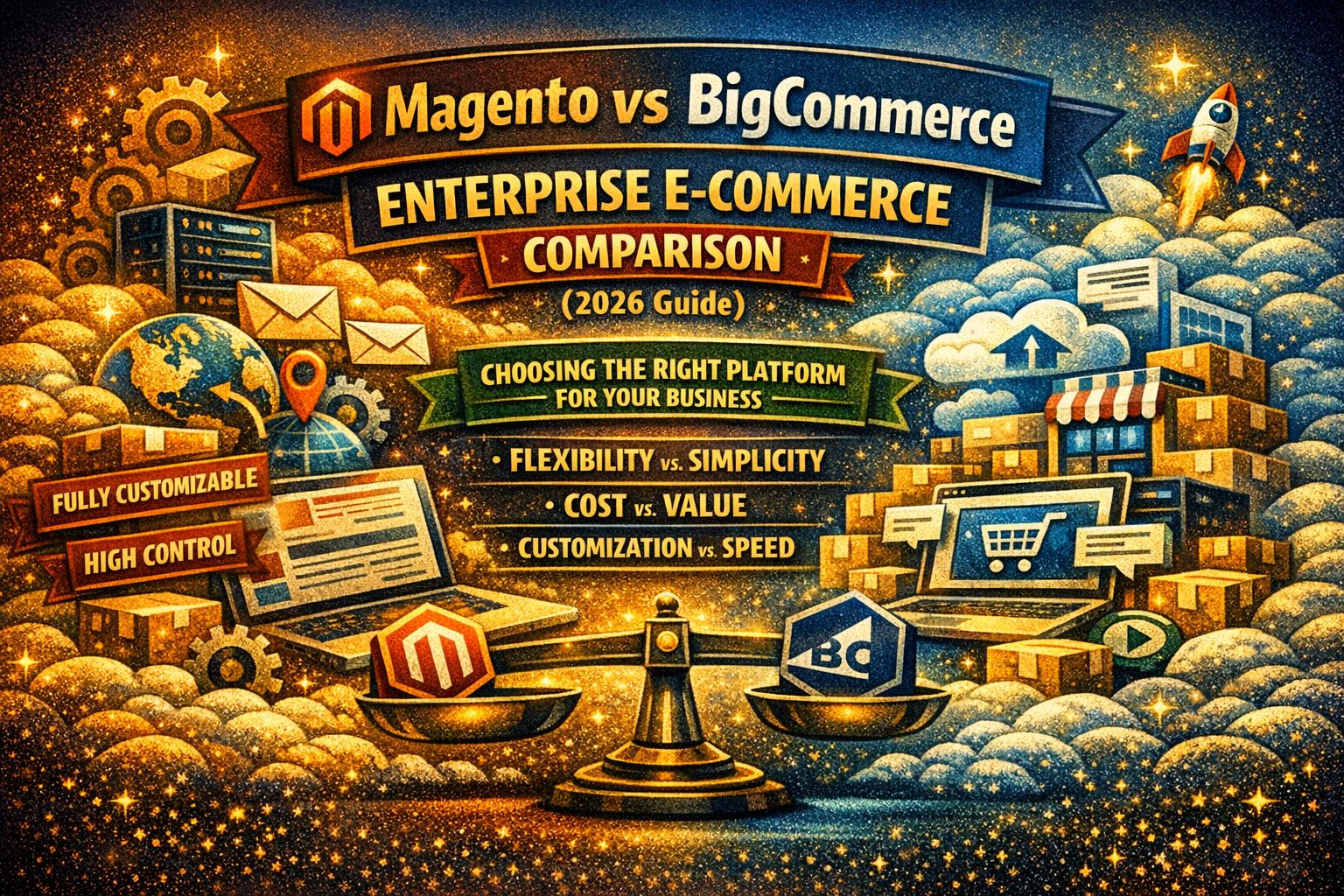
Choosing the right enterprise e‑commerce platform can determine everything—your scalability, performance, operational efficiency, and long‑term profitability. Two of the most powerful platforms competing in this space today are Magento (Adobe Commerce) and BigCommerce Enterprise.
Both are capable, flexible, and built to support high‑volume brands. But which one is right for your business? This guide breaks it down clearly so you can make a confident, strategic decision.

TL;DR
- Magento (Adobe Commerce): Best for large brands that need deep customization, full control, and complex multi‑store architectures.
- BigCommerce Enterprise: Best for fast‑scaling brands that want speed, lower maintenance, and easy integrations without heavy development costs.
The right choice depends on your team size, budget, customization needs, and growth plans.
Magento vs BigCommerce: In‑Depth Comparison
1. Platform Architecture & Flexibility
Magento (Adobe Commerce)
Magento is an open‑source (or enterprise) platform offering unmatched customization.
You get:
- Full access to codebase
- Ability to build custom features from scratch
- Unlimited control over design and logic
- Support for complex catalog structures and multi‑store setups
This makes Magento perfect for enterprises that need highly tailored workflows or unique customer experiences.
BigCommerce Enterprise
BigCommerce is a hosted SaaS platform designed for simplicity and speed.
You get:
- Fast deployment
- Lower developer dependency
- Headless capabilities
- Stable, secure infrastructure out of the box
It’s built for brands that want enterprise power without heavy technical overhead.
2. Scalability & Performance
Magento
Magento can scale extremely well—but only with proper hosting, optimization, and ongoing maintenance.
High performance requires:
- Skilled developers
- Dedicated hosting or cloud servers
- Continuous optimization
Best for enterprises with large catalogs, global traffic, and full in‑house tech teams.
BigCommerce
BigCommerce handles scaling automatically because it’s SaaS.
Benefits include:
- High uptime
- Automatic updates
- Faster page load times
- Zero infrastructure worries
Perfect for brands expecting rapid growth without increasing technical staff.
3. Total Cost of Ownership
Magento
Magento typically involves higher long‑term costs:
- Hosting fees
- Development & maintenance
- Security patches
- Custom build costs
It’s ideal for businesses with the budget for enterprise‑level engineering.
BigCommerce
Costs are predictable and lower:
- Fixed monthly/annual subscription
- No hosting fees
- Minimal development required
- Native features reduce plugin costs
Better for brands wanting enterprise results without enterprise‑level expenses.
4. B2B & Enterprise Features
Magento
Magento shines in B2B out of the box:
- Custom pricing
- Bulk ordering tools
- Advanced permissions
- Multi‑warehouse support
- Quote management
It’s built for manufacturers, distributors, and large multi‑store retailers.
BigCommerce
BigCommerce also offers strong B2B features, especially combined with its ecosystem of apps:
- Customer groups
- Volume pricing
- Shared product lists
- Punchout integrations
- Corporate account structures
Great for mid‑market and fast‑growing B2B brands.
5. Integration & Headless Commerce
Magento
Magento supports deep API customization and integrates with ERP, PIM, CRM, and custom enterprise systems.
Ideal when you need:
- Headless builds
- Complex backend workflows
- Advanced data pipelines
BigCommerce
BigCommerce is one of the most “headless‑ready” SaaS platforms:
- Strong API performance
- Easily integrates with CMSs, apps, and ERPs
- Faster headless deployments
Best for modern brands adopting MACH principles (microservices, API‑first, cloud‑native, headless).
6. Ease of Use & Maintenance
Magento
- More complex
- Requires ongoing development
- Longer onboarding
- Significant technical skill required
Ideal for teams with developers or agency partners.
BigCommerce
- Extremely user-friendly
- Minimal maintenance
- Automatic upgrades
- Fast onboarding
Great for teams that want to focus on marketing and sales, not engineering.
Which Platform Should You Choose?
Choose Magento (Adobe Commerce) if you need:
- Deep customization
- Multi‑store, multi‑region architecture
- Highly complex B2B operations
- Full ownership of your tech stack
- Custom, enterprise-grade experience
Choose BigCommerce Enterprise if you need:
- Faster launch
- Lower operational costs
- Strong native features without heavy coding
- Easy integrations
- Scalable SaaS infrastructure
Final Verdict
There’s no single “best” platform—only the one that aligns with your business model, resources, and long‑term vision.
- Magento is like building a custom mansion.
- BigCommerce is like moving into a luxury, ready-to-live enterprise suite.
Both are powerful. Your choice depends on the level of control vs. simplicity you prefer.
Want a Personalized Recommendation?
Tell me your catalog size, team structure, and business goals — I’ll help you decide whether Magento or BigCommerce is the perfect fit for your enterprise!