TL;DR
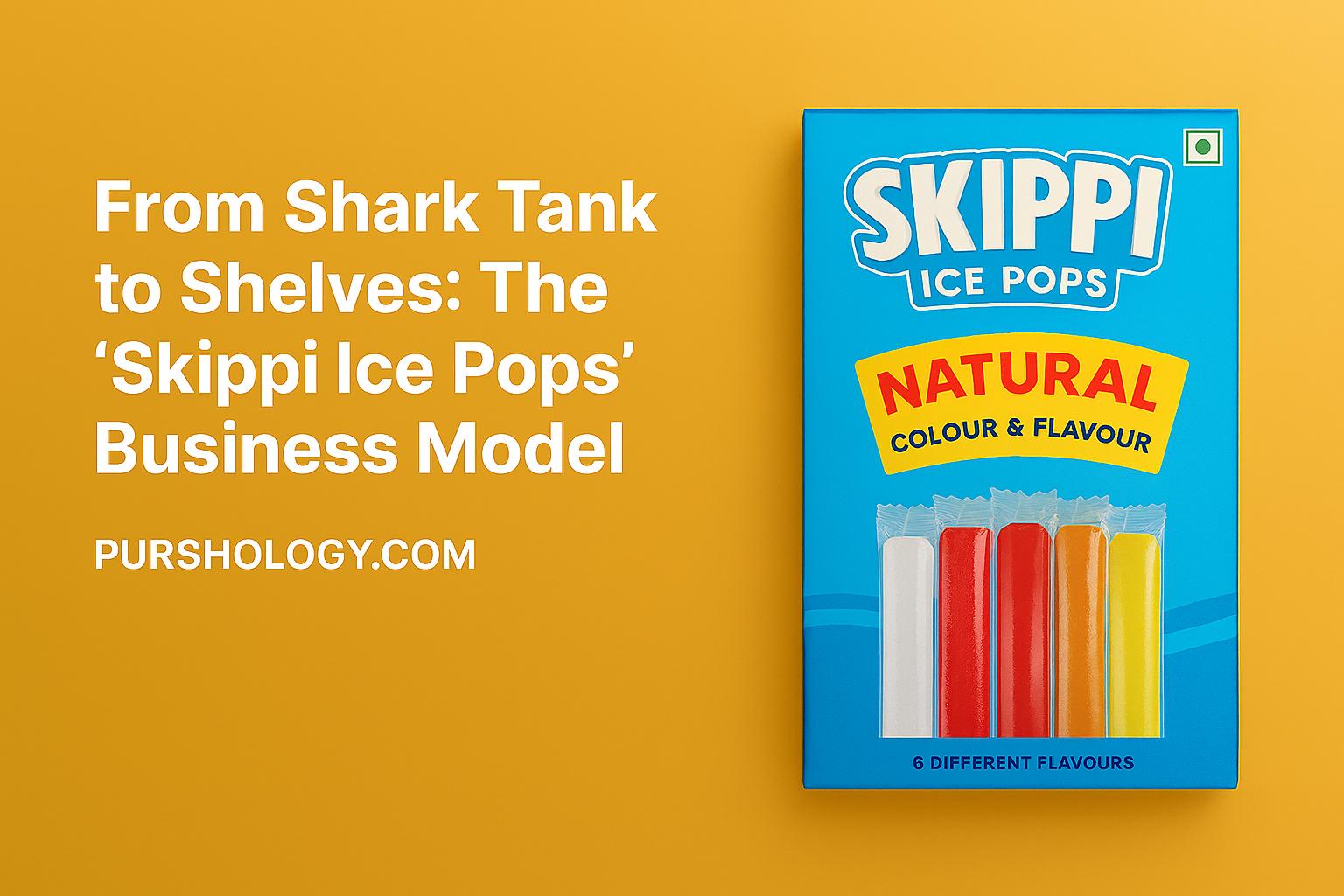
Skippi Ice Pops turned a nostalgic ₹10 product into a national FMCG brand after appearing on Shark Tank India. Its success wasn’t just about TV exposure—it was driven by a simple product, wide distribution, impulse pricing, and asset-light manufacturing. Skippi proves that in FMCG, scale comes from reach and recall, not complexity.
Introduction: Turning Nostalgia into a Scalable Business
Ice pops weren’t new to India. Almost every Indian childhood included them—locally made, brightly colored, and sold outside schools.

What Skippi Ice Pops did differently was organize the unorganized.
When the brand appeared on Shark Tank India, it put a spotlight on a deceptively simple question:
Can a low-ticket, nostalgia-driven product build a national FMCG brand?
Skippi’s journey from TV pitch to supermarket shelves answers that with a decisive yes.
The Core Insight: India Loves Impulse, Not Instruction
Skippi understood three fundamental consumer truths:
- Ice pops are impulse purchases
- Price sensitivity is extreme below ₹20
- Brand recall matters more than differentiation
Rather than over-engineering the product, Skippi focused on:
- Visibility
- Availability
- Consistency
In FMCG, being everywhere often beats being better.
Strategy 1: Extreme Simplicity in Product Design
Skippi didn’t try to reinvent frozen desserts:
- No premium positioning
- No complex flavors
- No health-first storytelling
The product worked because:
- It was instantly understandable
- It required zero consumer education
- It triggered childhood memory recall
This reduced marketing friction dramatically.
Lesson: Familiarity is a growth accelerator.
Strategy 2: Impulse-Friendly Pricing
Skippi’s price point made the buying decision almost subconscious:
- Low absolute cost
- No comparison shopping
- No regret window
This pricing:
- Increased trial rates
- Encouraged repeat buying
- Fit seamlessly into kirana and modern trade formats
Below a certain price, trust matters less than convenience.
Strategy 3: Distribution > Differentiation
Skippi’s real competitive advantage wasn’t branding—it was distribution discipline.
The company aggressively focused on:
- General trade (kiranas, small retailers)
- School-adjacent vendors
- Tier 2 and Tier 3 towns
- Modern retail chains post-Shark Tank
This mirrors classic FMCG thinking:
If it’s not visible, it doesn’t exist.
Strategy 4: Asset-Light Manufacturing Model
Unlike legacy FMCG giants that own factories, Skippi leaned toward:
- Contract manufacturing
- Standardized recipes
- Centralized quality control
This allowed:
- Faster scaling
- Lower capital expenditure
- Geographic expansion without fixed-asset drag
Capital efficiency mattered more than vertical control.
Strategy 5: Shark Tank as a Credibility Multiplier
The Shark Tank appearance did three things immediately:
- Built instant national awareness
- Opened doors with distributors and retailers
- Reduced trust friction with channel partners
Importantly, Skippi used the show as a launchpad, not a crutch:
- Rapid shelf onboarding
- Faster GTM execution
- Momentum-driven expansion
Media became leverage, not strategy.
Strategy 6: FMCG Fundamentals Over Startup Playbooks
Skippi avoided common startup traps:
- No burn-heavy digital marketing
- No over-branding early
- No chasing premium margins
Instead, it executed FMCG basics exceptionally well:
- Low margins × large volumes
- Tight supply chain control
- Seasonal demand planning
This made the business resilient, not just visible.
Why Skippi Worked When Many Don’t
Most consumer startups fail by:
- Overestimating brand importance
- Underestimating distribution difficulty
- Ignoring unit economics at low price points
Skippi flipped this:
- Distribution first
- Product second
- Brand last
That order matters enormously in FMCG.
Business Model Snapshot
- Product: Simple frozen ice pops
- Pricing: Ultra-low, impulse-driven
- Manufacturing: Asset-light, scalable
- Distribution: General trade–led
- Marketing: Recall over storytelling
Nothing fancy—just disciplined execution.
Key Lessons for Consumer Founders
- Complexity kills scale in mass FMCG
- Distribution is the real moat
- TV exposure only works if ops are ready
- Low-ticket products need high velocity
- Nostalgia can outperform novelty
Final Thought: Boring Done Right Wins Big
Skippi Ice Pops didn’t chase trends, health claims, or premium positioning. It chased availability.
By respecting how India actually buys—not how pitch decks imagine it—Skippi moved from Shark Tank curiosity to retail staple.
Sometimes, the smartest strategy is to make the obvious work at scale.
✅ If you’re building a consumer or FMCG brand:
- Ask whether scale comes from features—or from reach
- Revisit pricing as a growth lever, not just margins
- Nail distribution before narrative
Because as Skippi shows—in India, shelves matter more than screens.