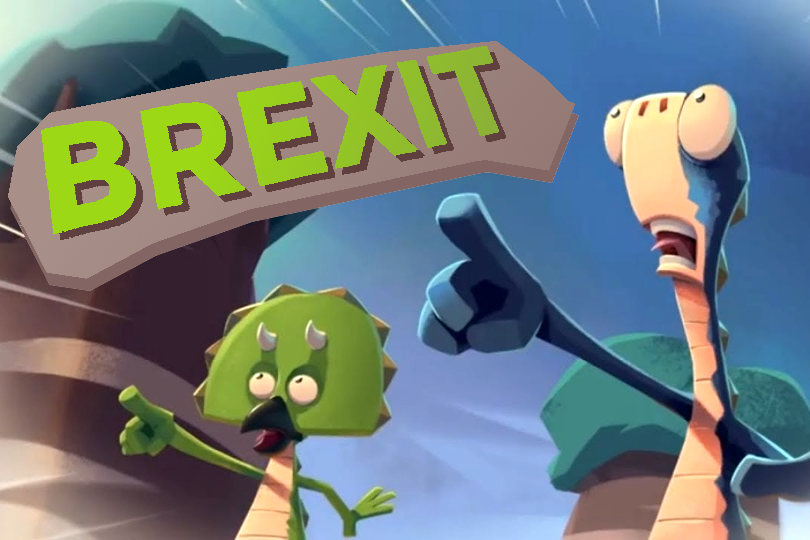
You may be forgiven for unfamiliarity with the story of the gigantosaurus, especially if you don’t have young children.

The gigantosaurus is a book by Jonny Duddle, essentially it’s a modern version of the ‘boy that cried wolf’ and worth adding to any parents collection. The story for anyone still in the dark, is one of a small dinosaur called Bonehead, who volunteers to be the lookout for his friends while they play. After repeatedly warning of impending doom in the form of the gigantosaurus on several occasions, his friends ignore him and finally when the mighty prehistoric beast appears for real his friends don’t believe him.
The parallels with Brexit seem stark. The third deadline is rapidly approaching after two botched attempts. I for one have become immune to the relentless barrage of options and outcomes. Time itself limits the potential for the third deadline to be honored, despite the promises of the leading Conservative leadership candidate.
Large multi-nationals with seemingly limitless resources, have prepared for the scenarios they can foresee. SME’s are not as fortunate. Back in January, less than half had plans in place for Brexit according to one survey.
The landscape doesn’t look so different this time around, few additional businesses have planned. It’s quite easy to see why. Business, in order to prepare, need to see an expected final destination and construct a route around potential pitfalls. Certainty is lacking, especially given that two of the outcomes are polar opposites, requiring different strategy.
A personal example. My business, Welland Power, builds diesel generators, predominantly for export outside of the EU. We have grown rapidly recently and hold the Queens Award for International Trade.
Ignoring my supply chain risk on the diesel generators major components for the moment, my main focus is on the movement of Sterling against the Euro and the Dollar. As Sterling falls, my products become more competitive to my international customers, as it rises, less competitive.
Short-term, in a no-deal scenario, I expect the pound to fall, which should generate a lot of interest in our products. If we decide to stay in the EU, the pound may rise, having the opposite effect.
How can I plan for both scenarios? In the first I need lots of stock to satisfy demand, in the latter I need almost no stock as my sales will fall sharply. That is of course based on my currency forecast, whereas i could be wrong. You can always be wrong.
Regardless of if you choose to listen to Bonehead (I will leave this analogy to your own individual preference), try to protect yourself for whatever outcome may finally arrive. With the two extremes seemingly more likely, a rapid change in either direction will certainly destroy some businesses, who have not planned, or planned for the wrong outcome.
Consider your planning under both scenarios and make sure it holds up to the dangers that lie ahead.
Current-year updates, best practices, and considerations
Some of the specific Brexit “deadline” dynamics referenced above are now historical, but the underlying lesson remains timely: repeated warnings can numb decision-makers, and uncertainty can tempt businesses into inaction. In the current year, the most relevant shifts and best practices to layer onto this piece are:
– **Treat “political risk” as a standing business function, not a one-off project.** Many firms that built basic risk capability during the Brexit years later let it decay. The better practice now is to maintain a lightweight, repeatable process (quarterly is often enough): a short risk register, clear owners, trigger points, and pre-approved actions.
– **Operational resilience expectations are higher than they were.** Customers, lenders, and insurers increasingly expect evidence that a business can withstand shocks (border disruption, supplier failure, cyber incidents, sharp FX moves). Even for SMEs, documenting contingency plans, redundancy in critical suppliers, and response procedures can help in negotiations and renewals.
– **FX volatility planning is more disciplined and more accessible.** Currency swings remain a structural reality for exporters and importers. Best practice is to separate “views” from “controls”:
– Define what you’re protecting (margin, cash flow, price stability).
– Set hedging policies with limits (how much, how far out, under what conditions), rather than making ad-hoc calls.
– Use scenario bands (best/base/worst) and decide in advance what you do at each band (stock, pricing, forward cover).
– **Inventory strategy has shifted toward flexibility, not just “more” or “less.”** Instead of committing fully to high- or low-stock positions based on a single forecast, many firms now combine: supplier lead-time reduction work, dual-sourcing where feasible, strategic safety stock only on true bottlenecks, and clearer customer delivery commitments tied to real capacity.
– **Supply-chain mapping is now a competitive advantage for SMEs.** A common weak point is knowing tier-1 suppliers but not the sub-tier dependencies that create surprise shortages. The current best practice is a pragmatic map of critical components: who makes them, where, lead times, substitute options, and what happens at the border or with regulatory checks.
– **Contracts and Incoterms deserve periodic refresh.** If you export/import, small improvements here can reduce nasty surprises: clarify responsibility for duties, paperwork, and delays; align Incoterms to your actual control of shipping; review force majeure and price-adjustment clauses; and ensure customers understand what changes if clearance or transit times shift.
– **Avoid “binary” planning; build option-based playbooks.** The most robust approach is a set of pre-built playbooks that can be activated quickly when uncertainty resolves—so you’re not trying to build a plan at the same time as the market is moving. Keep them short: “If X happens, we do Y in the first 72 hours / first month.”
These additions keep the message evergreen—uncertainty punishes the unprepared—while reflecting the practical ways businesses now manage repeated shocks, shifting trade frictions, and currency-driven demand without betting the company on a single forecast.