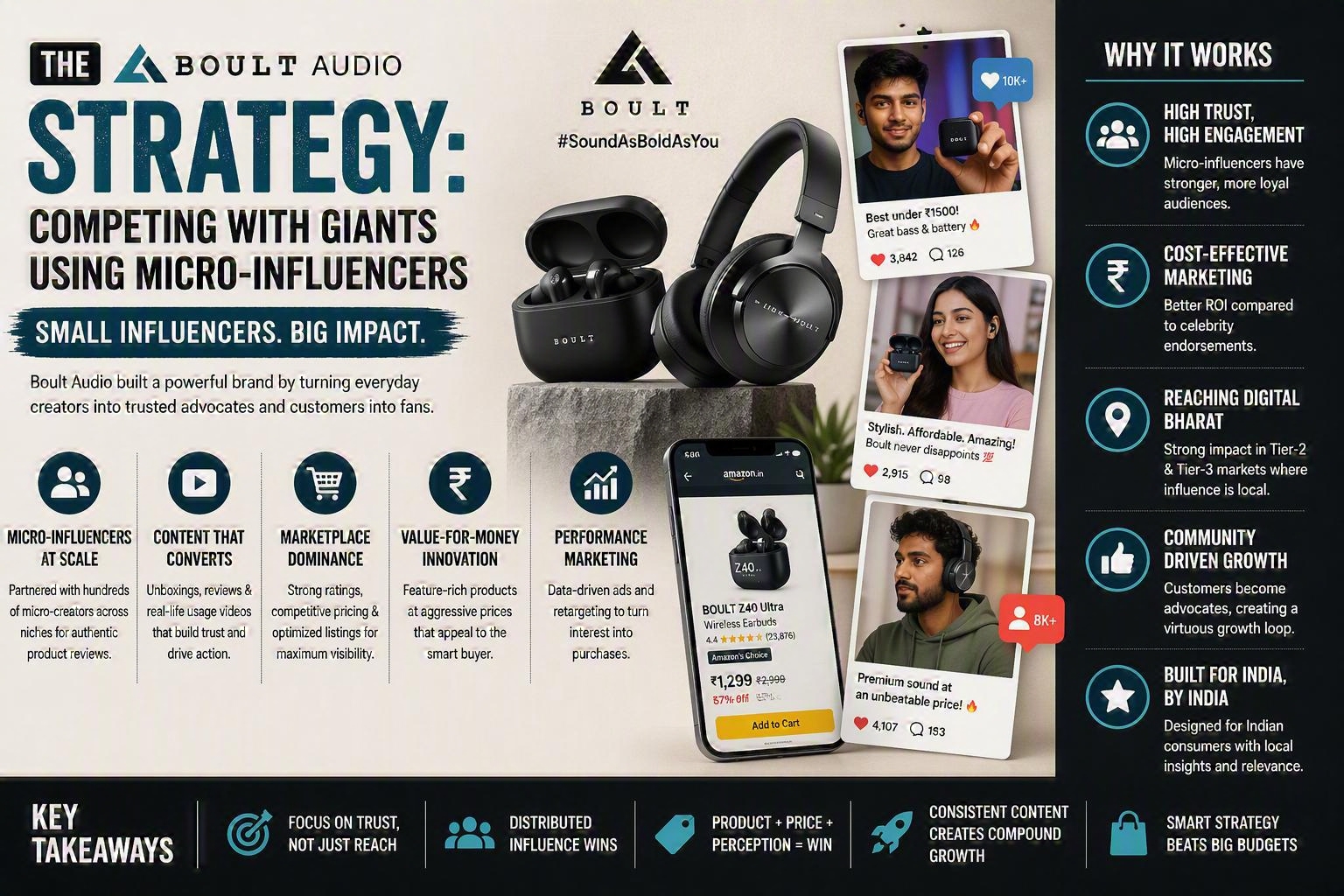
TL;DR
Boult Audio carved a strong position in India’s competitive audio market by leveraging micro-influencers, aggressive pricing, marketplace dominance, and aspirational branding. Instead of competing with big brands on budget-heavy campaigns, it built trust at scale through relatable creators and performance-driven marketing.
Introduction: Winning Without Big Budgets
India’s consumer audio market is dominated by global players like JBL, Sony, and Boat. Breaking into this space typically requires massive marketing spends and brand recall.

Yet, Boult Audio quietly scaled by doing the opposite:
👉 Low-cost, high-impact marketing through micro-influencers
This unconventional approach helped the brand connect deeply with a young, digital-first audience.
1. The Core Strategy: Micro-Influencer Power
Instead of spending crores on celebrity endorsements, Boult invested in hundreds of small creators.
Who are micro-influencers?
- Creators with 5K–100K followers
- Niche audiences (tech, fitness, gaming, lifestyle)
- Higher trust and engagement rates
Why this worked:
- Authentic product reviews
- Relatable content for tier‑2 and tier‑3 audiences
- Higher ROI compared to celebrity campaigns
👉 Boult didn’t aim for reach alone—it optimized for trust and conversion.
2. Volume Over Vanity: Scaling Creator Content
Boult’s approach wasn’t about one viral campaign—it was about consistent content volume.
Execution style:
- Hundreds of product reviews across platforms
- Unboxing videos, reels, short demos
- Continuous content instead of one-time launches
Result:
- Constant visibility in consumer feeds
- Reinforced brand recall
- Strong presence across YouTube Shorts, Instagram, and Amazon listings
👉 The brand became omnipresent without overspending.
3. Platform-Led Growth: Amazon as a Discovery Engine
Boult smartly leveraged e-commerce platforms as growth channels.
Key tactics:
- Optimized product listings with influencer content
- Strong focus on reviews and ratings
- Competitive pricing + frequent discounts
Why it mattered:
Consumers discovering products on Amazon often rely on: ✅ Ratings
✅ Reviews
✅ Visual proof (videos, testimonials)
Boult combined all three effectively.
4. Aggressive Pricing Strategy
Boult positioned itself as a value-for-money challenger brand.
Pricing approach:
- Slightly cheaper than premium brands
- Competitive with mid-range players
- Perceived “more features for the price”
Consumer effect:
- Easy trial for first-time buyers
- Strong appeal among students and young professionals
- High conversion in price-sensitive markets
5. Product Positioning: Style Meets Performance
Boult didn’t just focus on affordability—it ensured aesthetic appeal.
Design focus:
- Sleek earbuds and headphones
- Sporty, modern look
- Youth-driven branding
Combined with:
- Good battery life
- Solid sound performance
- Fitness-friendly features
👉 Result: A brand that feels premium without premium pricing.
6. Tier-2 & Digital Bharat Advantage
Boult’s micro-influencer strategy worked especially well beyond metros.
Why:
- Regional creators have stronger local influence
- Less competition from global brands in smaller markets
- Higher trust in “people like me” recommendations
This helped Boult:
✅ Penetrate deeper into non-metro markets
✅ Build grassroots brand awareness
✅ Scale faster than traditional ad-heavy models
7. Performance Marketing Integration
Boult didn’t rely only on organic influencer reach—it combined it with data-driven ads.
Strategy:
- Retarget users who saw influencer content
- Run conversion-focused ads on marketplaces
- Optimize campaigns based on purchase behavior
👉 This created a full funnel loop: Influencer awareness → Retargeting → Purchase
8. Brand Perception Shift: From Unknown to Challenger
Initially, Boult was an unknown brand. But over time, consistent exposure led to:
- Higher trust via repeated creator mentions
- Increased product visibility
- Strong marketplace rankings
It evolved into: 👉 A credible alternative to established audio brands
Key Lessons from Boult Audio’s Strategy
✅ Micro-influencers drive trust at scale
✅ Consistency beats one-time virality
✅ E-commerce is the new battleground
✅ Pricing + perception = conversion
✅ Relatability wins in emerging markets
Conclusion: The Rise of Distributed Influence
Boult Audio proves that brands no longer need massive budgets to compete—they need smart distribution of attention.
By decentralizing marketing across hundreds of creators, it achieved something powerful: 👉 Trust at scale, not just visibility
In today’s creator economy, influence isn’t concentrated—it’s distributed. And Boult leveraged that shift brilliantly.
🚀 If you’re building a D2C or consumer brand,
take inspiration from Boult’s playbook:
Don’t chase big influencers—build a network of believers.
Found this useful? Share it with your team, bookmark it for your next growth strategy session, and explore more insights on brands winning with unconventional thinking.