
Video content impacts organic performance more than any other asset that can be displayed on a web page. In today’s online marketing world, videos have become an integral step in the user journey.

Yet for the large enterprises, video optimization is still not an essential part of their website optimization plan. Video content is still battling for recognition among the B2B marketer. Other industries, on the other hand, have already harnessed this power of video.
In the recent Google Marketing Live, Google mentioned that 80% of all online searches are followed by a video search. Some other stats to take into consideration, according to Smallbiztrends by 2019, global consumer Internet video traffic will account for 80% of all consumer Internet traffic. Furthermore, pages with videos are 53 times more likely to rank on Google’s first page.
I took a deeper look into video content and its impact on organic performance. My analysis started in the fall of 2018. Google had already started to display video thumbnails in the SERPs. According to research from BrightEdge, Google is now showing video thumbnails in 26% of search results.
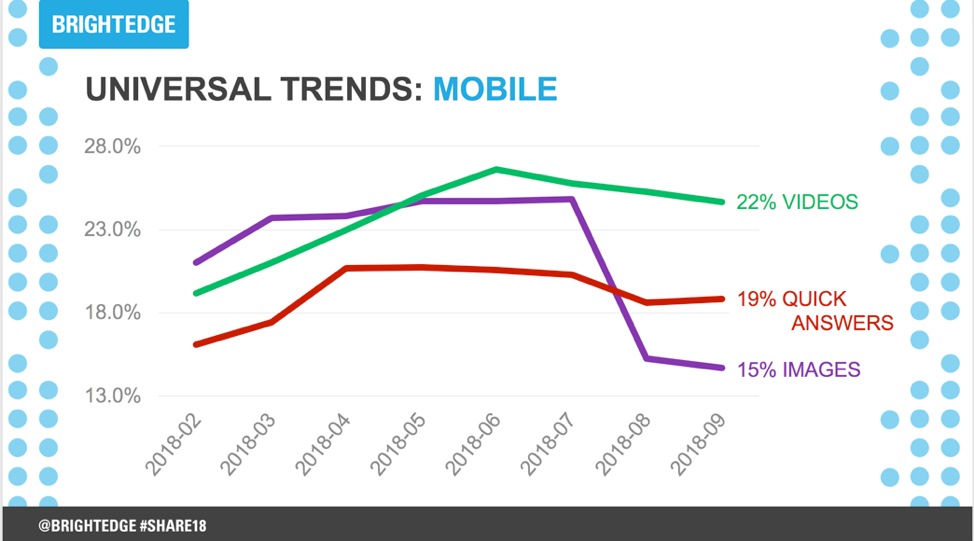
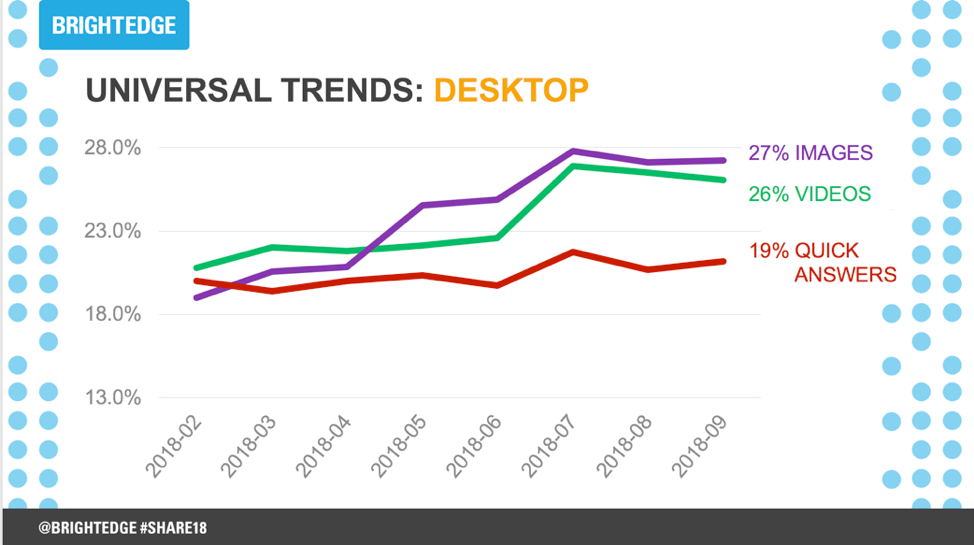
Source: BrightEdge
Understanding the true influence of video SEO for your business will require some testing. I did four different sets of tests to arrive at the sweet spot for our pages.
The first test was to gauge if having video content on the page made any significant changes. I identified a page that ranked on page four of the SERP’s in spite of being well optimized. The team placed video content relevant to the textual content to the page. And the test result was loud and clear, having a video on the page increased relevance, resulting in increased rankings, and visibility in universal search. The Page started to rank on page one and the video thumbnail in the SERPs displayed the desired video and linked back to the page.
The next test was to understand the impact of the method of delivery. I measured what was the level of user engagement and organic performance when video contents are displayed/delivered on the page via different formats. The page was set up wherein users could get access to the video content either via a link that would take the user to YouTube or as a pop-up or as an embedded file that actually plays the video on the page itself. Results were very evident – every time the video was embedded on the page the user engagement increased, which decreased the bounce rate, and improved page ranking.
Taking a step further in our testing journey, I conducted a follow-up test to evaluate which category of video content performs better? Like any other SEO strategy, video optimization isn’t different. Skip the marketing fluff and go for product feature videos, “how-to” videos, or “what is” videos. We tested assorted video contents on the same page. Whenever the content of the video addressed a user need and was relevant to the page textual content the page rankings improved.
Lastly, I tested if Google prefers YouTube videos or domain hosted videos. On this subject, several of my business colleagues and I have budded heads. There is no universal truth. Google does display both YouTube and domain hosted videos in the thumbnails on the SERPs. Different sites will see different results. I tested the impacts of an embedded YouTube video on the page. What I found was something I had not even considered in my hypothesis. When the video was already present on YouTube and then embedded on the page, the URL improved in rankings and at the same time the thumbnails on the SERPs showed the YouTube video but when the user clicked on the video it took them to the product page and not to the YouTube video.
Key takeaway
Many enterprise SEO strategists failed to leverage the video content because they feel their products are not that B2C in nature. Remember that search engines like videos because searchers like videos.
Videos take the static image or textual content to experience content, wherein the user can actually view how to use the information. This brings in a much higher and stronger level of engagement that in turn improving the brand reputation.
What video content should you consider?
I recommend starting at square one – what is the user intend/need you are trying to address. Define the goals you want to achieve from this video marketing. Are you looking to drive conversions or spread brand awareness? Put some thought into whether the video is informative and engaging and whether it is relevant to the page that it is displayed in.
Don’t overlook how that message is conveyed as well. Take into account personas as that establishes your intended target audience, the overall tone that the video should take. What stage of the user journey is being targeted? Understanding the areas where video results are high can help provide insight and guidance for additional content strategy ideas.
Things to remember when starting to incorporate video content
More and more people are searching and viewing content on their handheld devices. Therefore, you have to optimize this content with a mobile-first approach.
The basic SEO principle still applies. Optimize title, description, tags, transcript. Matching these to the user intent can encourage click-throughs
- Ensure its page placement. Always surround your video with relevant content to tie it all together.
- Videos up to two minutes long get the most engagement. Keep them short and let your brand shine through.
Don’t just link to it, embed it onto your site and make sure the video image is compelling.
This is the critical time to incorporate video content and optimization into your content strategy for 2019. When quality videos are added to web pages, it gets recognized as rich content, a step up from the regular text-filled pages. Video content will only help your optimization strategy in expanding your reach to driving engaged site visits.
Tanu Javeri is Senior Global SEO Strategist at IBM.
Related reading

Free or freemium keyword research tools (not including obvious ones like Google Ads Keyword Planner) to provide useful insight into organic ranking opportunities, persona building, competitive research, product development, and more.

A brief idea of how you can rank a page on Google’s featured snippet, without building any links to that page. Types, techniques, and screenshots included.

From URL mapping to testing, five ways in which the expertise of an SEO professional can propel your website towards successful migration.

Look around at a macro-level to see the trends vs. always focusing on detailed keyword level optimizations. Trends to help put your strategy in context.
What’s changed recently (and what to prioritize now)
Video still meaningfully supports organic performance, but the mechanisms that drive that value have evolved. The highest impact now comes from (1) *eligibility and visibility* in rich results and video surfaces, (2) *measurable user satisfaction* signals tied to speed and experience, and (3) *how well the page/video pairing fulfills intent*, especially on mobile. Below are the current best practices and considerations to make video an advantage without creating new SEO or performance risks.
### 1) Treat video as “indexable content,” not just an on-page enhancement
If search engines can’t confidently understand a video (what it’s about, where it lives, what page represents it), you may get the engagement benefits but miss out on video thumbnails, video mode visibility, or rich result eligibility.
**Best practices**
– Add **VideoObject structured data** on the canonical page where the video is primarily featured.
– Ensure the **video is actually present and playable on the page** (not only behind interactions that bots may not trigger).
– Provide a clean, crawlable **thumbnail URL**, title, description, and (when possible) upload date/duration.
### 2) Performance and Core Web Vitals matter more when you embed video
Embedding increases engagement—but it can also inflate JavaScript, delay rendering, and hurt INP/LCP if implemented poorly. A “video-first” page that loads slowly can lose ranking ground despite strong content relevance.
**Best practices**
– Use a **lightweight embed** pattern (click-to-play preview, deferred loading) so the player doesn’t block initial rendering.
– Reserve space to avoid **layout shift** (explicit width/height or responsive container with fixed aspect ratio).
– Use an optimized **poster image** and consider modern formats where appropriate.
### 3) Double down on accessibility and “understandability” signals
Search engines rely heavily on text and metadata to interpret video. Users also increasingly expect accessible experiences.
**Best practices**
– Publish **transcripts** (on-page, crawlable) and add **captions** to the video.
– Make sure the video is surrounded by **supporting copy that matches the same intent** (don’t force users to watch to get the answer).
– Use clear headings so the relationship between page topic and video topic is unambiguous.
### 4) Don’t split equity and intent across too many competing URLs
Many enterprise sites accidentally create multiple “owners” of the same video (landing page, blog post, product page, help article), diluting signals and confusing which URL should rank.
**Best practices**
– Decide which page is the **primary canonical destination** for search.
– If you republish the same video elsewhere, adjust the page purpose (e.g., summary + link) rather than making duplicates compete head-to-head.
– Keep internal linking consistent toward the preferred page.
### 5) YouTube vs. self-hosting: optimize for the outcome you want
There still isn’t a universal winner. The current practical approach is to choose based on your goal and analytics/attribution needs.
**Considerations**
– **YouTube** can be excellent for discovery and incremental reach, but it may shift some user journeys to the platform unless your strategy is designed to pull users back.
– **Self-hosting / enterprise platforms** give more control over performance, UX, CTAs, and measurement, but require stronger technical execution (delivery, crawlability, structured data, thumbnails).
A common hybrid approach is: publish on YouTube for reach, embed on the site for engagement and conversion—while ensuring the site page is the primary “SEO target” using consistent metadata and structured data.
### 6) Make video support the page’s primary intent (avoid “decorative” video)
Video helps rankings most when it *resolves the query better than text alone*. If it’s generic brand footage on an intent-specific page, it can increase load time without improving satisfaction.
**Best practices**
– Prioritize **how-to, demo, troubleshooting, comparison, and “what is”** formats when the query implies learning or evaluation.
– Keep it tight: aim for the shortest runtime that fully answers the need.
– Place video near the section it supports, not buried at the bottom.
### 7) Measure beyond rankings: validate the “why” behind performance changes
Because video can influence engagement, conversions, and visibility in multiple search surfaces, isolate impact with testing and segmented reporting.
**Best practices**
– Track changes in **SERP appearance** (video thumbnail/rich result), CTR, engaged sessions, and conversions.
– Segment by **device** (mobile vs. desktop), because video UX and load cost differ significantly.
– Run A/B or time-boxed tests when possible, controlling for content updates and template changes.
### 8) Watch for technical pitfalls that quietly suppress video value
These issues are common in enterprise environments and can prevent rich result eligibility or undermine performance.
**Common pitfalls**
– Videos blocked by **robots**, inconsistent rendering, or loaded only after heavy client-side scripts.
– Missing/incorrect **thumbnail URLs** or inaccessible thumbnails.
– Embeds that trigger **multiple requests and trackers** before user interaction.
– Using video in a way that causes **intrusive interstitial** experiences on mobile.
—
If you’d like, I can rewrite the above as a drop-in section that matches your article’s exact tone and formatting (subhead style, bullet density, and level of technical detail), or tailor it for B2B enterprise stakeholders vs. SEO practitioners.