
Google’s PageRank is one of the metrics that started it all. It was present in that very first research paper, that laid a foundation for Google’s entire ranking system.

PageRank figures out the importance, credibility and “weight” of a webpage, based on the type of backlinks that the webpage gets. It’s a system analogous to academic quotations. So the more robust your backlink profile is, the more appropriate and authoritative backlinks you receive, the higher your chances to rank.
We all know perfectly well what importance good backlinks have. The weight assigned to the page due to its backlink profile can make or break the ranking. And ever since PageRank was first adopted, the SEO community started trying to optimize for it. So it goes, they adopt, and we adapt.
During its long history as a vital ranking factor, PageRank was surrounded by a multitude of misconceptions. In this article, I will address some of the most prevalent ones.
1. PageRank as a metric is too old to matter
PageRank went out of public access in 2016. Before that, its last available update was in 2013. And the original algorithm was presented way back in 1999.
On the Internet, not just metrics, but entire tools can become outdated in a matter of weeks. So talking about an instrument from 1999 might seem like a bad idea to some.
And usually, I’d agree. But not in this case.
First of all, PageRank is, in many ways, one of the cornerstones of Google’s entire ranking system. PageRank (PR) was originally created with a specific goal in mind – to help users avoid junk results in their searches. And it’s been fulfilling that function beautifully for years.
Second, it’s not exactly the same metric. PageRank’s formula has been updated dramatically (you can read a more in-depth review of the algorithm changes here). And that’s done in order to reflect the changes in the Internet landscape.
And on top of all that, there is also the news that PageRank’s patent is being prolonged by Google. So it’s pretty obvious that PageRank is still alive and well as a metric of a page’s weight.
Closely connected to the first is the second misconception.
2. Google isn’t using the PageRank tool since they stopped publicly updating it
First off, PageRank was never officially discontinued. It stopped being publicly available, sure. And Google hasn’t updated the publicly available version in years, yes.
But always keep in mind that Google states outright that they are still using PageRank after all these years.
This misconception stems from the fact that Google is no longer showing the public PR scores.
In the beginning, PageRank was an easily and conveniently accessible metric. By using Google Toolbar, you could simply click and see the one to ten value of any page you’re visiting.
That led to the overwhelming use of link spam by the malevolent SEO agencies to get juice from authoritative blogs and websites.
That needed to be stopped, so Google (along with a couple of other search engines) introduced a “nofollow” tag. That’s an attribute that you can use to stop PR from taking certain links into account so that you don’t lose your authority due to link spam.
But even after that, an entire economy grew out of SEO agencies and companies optimizing solely and purely for PR. It got to a point where it started hurting the actual users, at which point Google put their foot down.
3. There’s no way to gauge the weight of a page
Since PR stopped being public, there’s no way to gauge the weight of a page.
This is a tough one because it’s based on a very real, indisputable fact. Since PageRank became closed to the public eye, we can no longer see that metric. That’s pretty much the end of the story.
No company, no developer team, can actually claim to know precisely what PageRank says about any page.
But there are actually alternatives to PageRank, which are definitely useful to look at. Those are the tools like SEO PowerSuite’s InLink Rank, Moz’s Page Authority, and Ahrefs’ URL Rank.
Those are all built with the goal of substituting PageRank in mind. They try to give their users an easy way to understand the relative weight of a page due to the number and quality of its backlinks.
Every one of those alternative metrics uses specific algorithms to get closer to whatever the actual PageRank of a page would’ve been like.
(Note, full disclosure: Me being a creator of SEO PowerSuite, I can only fully vouch for that particular software. I suggest any reader interested to go and check out the work done by other teams.)
4. PageRank lost its weight
PageRank lost its weight compared to hundreds of other metrics that come in play for Google to determine rankings.
Now, the big question is, does it even matter that there are these alternative metrics available? Since there are hundreds, literally hundreds of metrics that Google uses, can we actually say that backlinks are as important as they once were?
To find this out, we did some research in-house. And we found a strong correlation between InLink Rank scores and Google SERP positions.
We found that the correlation between Domain InLink Rank and SERP ranking stands at a high enough number: 0.128482487. Which means that the backlink profile of a page plays a significant role in the placement of a page in the rankings.
So backlinks absolutely still play a huge role in the ranking of pages. For our part, we routinely perform this type of research, continually finding how important this metric is to the ranking. It’s now up to the webmasters and site admins to keep close tabs on their backlinks, using the available alternatives to PR.
5. You can’t influence your PageRank score
Obviously, even getting that PR score, the question is – To what extent can webmasters really influence it? How much can be done to improve your scoring?
Of course, we cannot really know how to increase PR. But we can definitely talk about some things that you need to avoid in order to not lose any of them.
Run a backlink analysis
We’ve already established that backlinks are still important for rankings. By using software to run backlink analysis you’ll see the type of backlinks you get. Then you can manage your profile that much easier.
Keep your content close to your homepage
It’s a truism that a user should never travel more than three clicks from your homepage. Make sure the important pages stay close to those of high PageRank and ensure that there are breadcrumbs for easier user navigation.
Use anchor text with relevant keywords
Create anchor text with the appropriate (but avoid stuffing at all costs) keywords. This achieves two things:
a) It lets your users orient themselves in your content a lot more.
b) It will help you with optimization.
Organically placed relevant keywords are a perfect way to tell the search engines about the actual content of your page.
Place your links carefully
Always know what kind of weight is carried by what kind of link. Links that you place in your content will be more valuable to PageRank than navigational ones. Keep the number of links out of your pages reasonable, don’t overdo it and damage your PR score inadvertently.
Shape your internal PageRank flow
Use “nofollow” tags and appropriately placed internal links to shape what pages get the highest ranking. For that, first, open an auditor tool to see what pages get the most rankings. In WebSite Auditor, you can see a convenient visualization with every one of your website’s subdomains laid out according to their InLink Rank score.
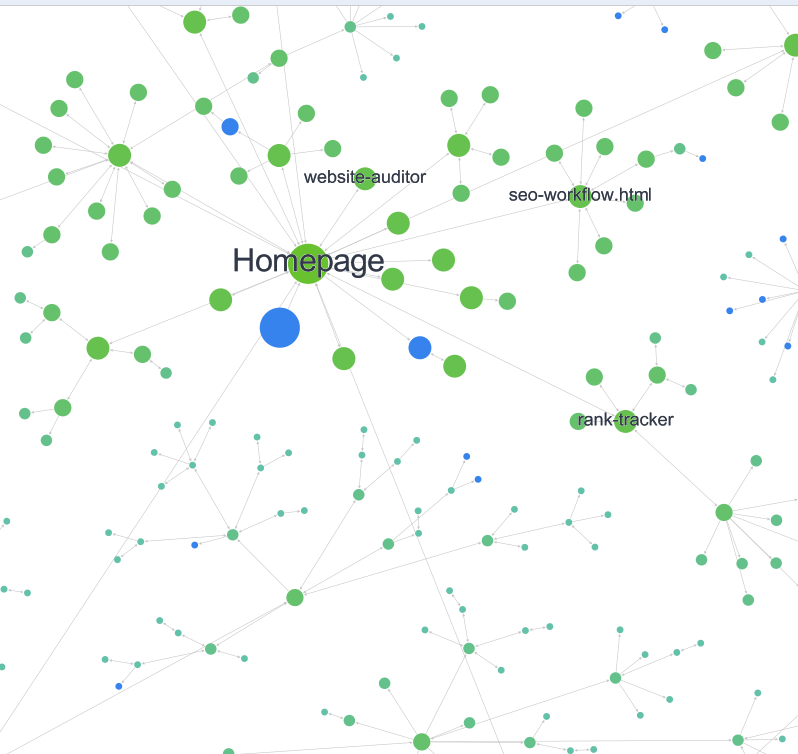
Based on that, you can easily create a little boost for the pages that don’t get enough ranking, by linking to them from your most important ones.
Perform a technical audit
By performing a technical audit, you can see the internal linking structure, and eliminate the dead links, 4xx pages, and much more, all of which influences your PR score.
Extra – Maximize your linkless mentions
Google is starting to look at your brand mentions, and using the info it found in order to evaluate domain authority. As we know, the algorithms used by Google rely more and more on users’ intentions nowadays than anything else. So the straightforward links will give way to linkless mentions, implied links. Growing linkless mentions is clearly much easier than running backlinks.
Use a social monitoring tool for this. Ideally, the one that has a web crawler of its own instead of relying on third-party databases (Awario comes heavily recommended). Looking through your brand mentions across the social media as well as millions of webpages, you’ll be able to manage your branding that much more successfully.
Conclusion
PageRank is still going strong as a metric used by Google for ranking. It’s been around since 1999, and it’s still one of the cornerstones of Google’s ranking of pages.
Since it’s been closed to the public eye, hundreds of new metrics sprung up, from the quality of images on your page to the existence of a privacy policy, and terms & conditions page that is easily available. But having a solid backlink profile is still as important as ever.
Luckily, due to a vast number of tools available on the market, you can see the state of your backlink profile, and influence it to help your pages and your domain grow. In 2019, it would be foolish to ignore any metric influencing growth. And it’s doubly true for a metric as important and fundamental as PageRank.
Aleh is the Founder and CMO at SEO PowerSuite and Awario. He can be found on Twitter at .
Related reading

Free or freemium keyword research tools (not including obvious ones like Google Ads Keyword Planner) to provide useful insight into organic ranking opportunities, persona building, competitive research, product development, and more.

A brief idea of how you can rank a page on Google’s featured snippet, without building any links to that page. Types, techniques, and screenshots included.

From URL mapping to testing, five ways in which the expertise of an SEO professional can propel your website towards successful migration.

Look around at a macro-level to see the trends vs. always focusing on detailed keyword level optimizations. Trends to help put your strategy in context.
New section: PageRank today — what’s changed and what to do now
PageRank (link-based authority) still matters, but the *way it’s applied and the ecosystems around links* have changed. If you’re updating this piece for the current year, these are the most relevant considerations and best practices—without turning the article into a year-by-year recap.
### 1) PageRank is still part of the system, but it’s not a “score you can game”
Google continues to use link analysis as an input, yet modern ranking is far more *contextual*: links are interpreted alongside relevance, intent, content quality, and spam signals. Practically, this means:
– A smaller number of highly relevant, editorial links can outperform large volumes of generic ones.
– “Authority” is increasingly topic- and context-sensitive, not just domain-wide.
### 2) Link attributes now shape how link equity is treated (and it’s mostly out of your control)
Google treats `rel=”nofollow”`, `rel=”sponsored”`, and `rel=”ugc”` as *hints* (not absolute directives) in many cases. Two implications:
– Don’t assume nofollowed links pass *zero* value or tracked attention—but also don’t build strategies that depend on sculpting with nofollow.
– Use the right attribute on your own site to avoid sending quality/spam signals (paid links should be labeled `sponsored`, user-generated areas should use `ugc` where appropriate).
### 3) “PageRank sculpting” via internal nofollow is largely outdated; internal architecture wins
Historically, SEOs tried to “channel” PageRank by nofollowing internal links. Today, the safer, more effective approach is structural:
– Keep important pages reachable via clean internal linking (hub pages, breadcrumbs, contextual links).
– Reduce crawl waste (faceted duplicates, infinite spaces, thin tag pages) rather than trying to micromanage equity flow.
– Use canonicalization and sensible information architecture to consolidate signals.
### 4) Link quality evaluation is more sophisticated (spam detection is better)
Google is better at discounting manipulative patterns, including:
– Scaled guest posting/link exchanges done primarily for links
– Low-quality digital PR networks
– Sitewide footer/sidebar placements bought or swapped
– Expired domain repurposing purely to pass value
Best practice: prioritize links that are **editorial, earned, and contextually justified**, and avoid footprints that look like campaigns built “for SEO only.”
### 5) Expect less “raw link juice” and more emphasis on relevance + usefulness signals
Links are still foundational for discovery and authority, but competitive queries now require a baseline of:
– Helpful, original content aligned to intent
– Strong on-page relevance (clear topical focus, entity coverage)
– Good UX and technical hygiene (indexability, performance, clean templates)
In other words: links can’t reliably “rescue” mismatched intent or thin content the way they sometimes could in earlier eras.
### 6) The best link-building today looks like brand building + distribution
The most resilient approaches are the ones that naturally produce citations and links:
– Digital PR with real news/value (data studies, tools, expert commentary)
– Partnerships where a mention is genuinely useful to the audience
– Community-led discovery (forums, events, niche publications)
– Original resources people reference (calculators, templates, glossaries, benchmarks)
This also reduces the risk that future link spam improvements wipe out your gains.
### 7) Measuring “PageRank alternatives” is useful—but treat them as directional
Third-party metrics (URL-level authority scores, link ratings, etc.) are still practical for comparative analysis, but:
– Use them to spot *relative* strength, not to predict rankings.
– Combine them with topical relevance checks, anchor context, traffic estimates, and indexation.
### 8) Linkless mentions: worth caring about, but don’t treat them as a link replacement
Brand mentions (even without hyperlinks) can correlate with authority and trust, and they can drive discovery that *leads to* links. The practical takeaway:
– Track mentions for reputation and PR opportunities.
– Still pursue real editorial links where appropriate—mentions are complementary, not a substitute.
**Evergreen takeaway:** PageRank-style link authority remains a core concept, but current best practice is to earn fewer, better links; invest in internal architecture; and avoid tactics that create obvious manipulation patterns.