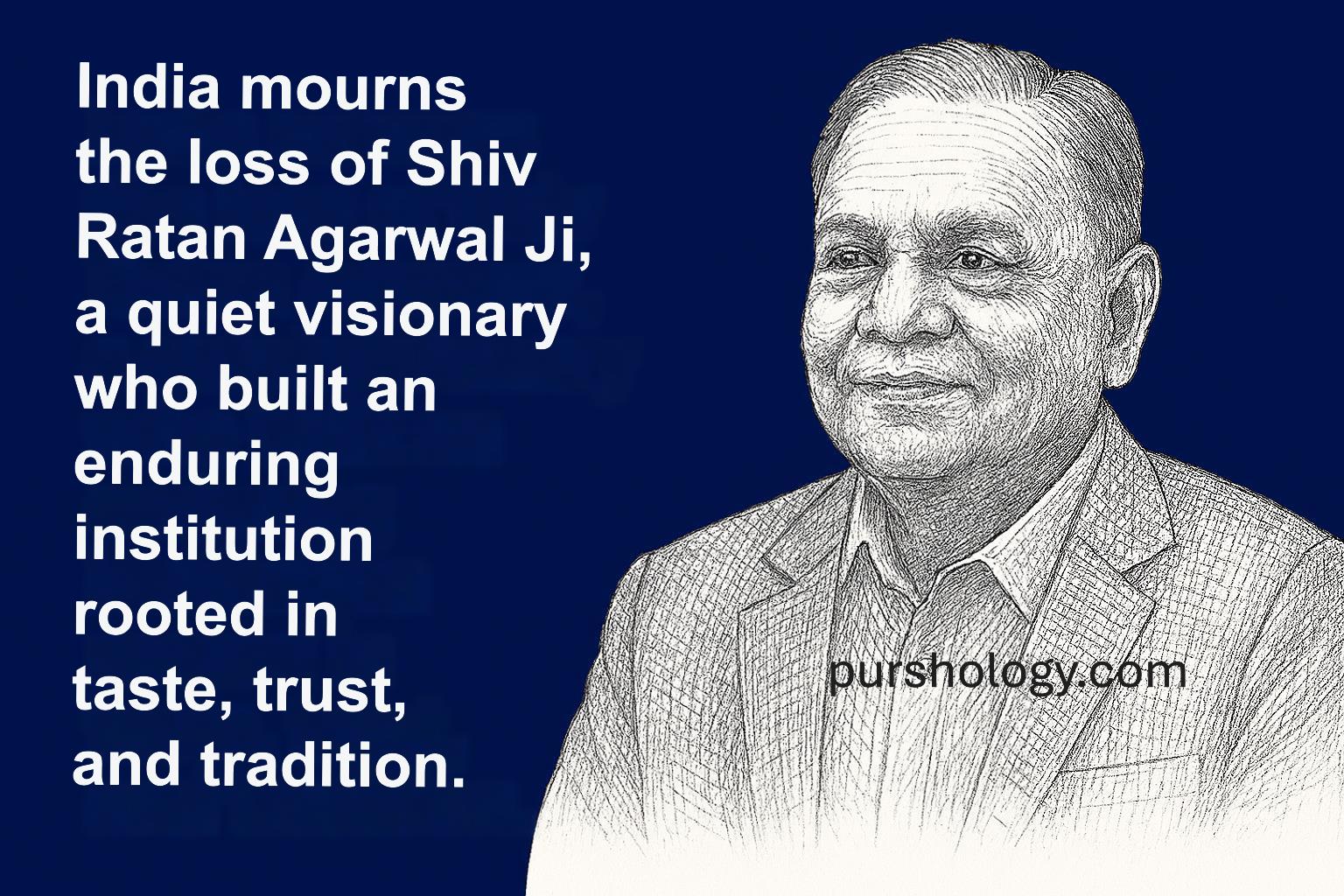
In a country filled with FMCG giants chasing scale through capital and advertising, Bikaji’s story stands apart.
It didn’t begin in boardrooms or business schools.
It began in Bikaner, with a family recipe, relentless discipline, and an uncompromising focus on taste.

This is the story of late Shiv Ratan Agarwal, and how a humble regional snack—Bikaneri Bhujia—became the foundation of a ₹17,300 crore listed FMCG powerhouse.
A life built on values, patience, and purpose—Shiv Ratan Agarwal leaves behind a legacy far greater than numbers.This is The Bikaji Playbook.
TL;DR
- Bikaji started as a family-driven, region-first snacks business
- Founder Shiv Ratan Agarwal focused on product authenticity over speed
- Expansion was deliberate, not rushed
- Distribution depth mattered more than national ads
- Bikaji scaled without losing its core identity
- The result: one of India’s most successful traditional FMCG stories
The Origins: Where It All Started
Bikaner has long been synonymous with bhujia—but for decades, it remained a local delicacy, not a national brand.
Shiv Ratan Agarwal was deeply involved in the traditional snack-making ecosystem of Bikaner. What set him apart was not invention, but intent:
To commercialize tradition—without corrupting it.
Instead of reinventing bhujia, he standardised it:
- Consistent taste
- Scalable processes
- Affordable pricing
- Longer shelf life
Bikaji Foods International was founded on one clear belief: Traditional Indian food could scale nationally—if respected, not diluted.
Playbook #1: Product Authenticity Is the Moat
Unlike many FMCG brands that tweak products to suit mass palates, Bikaji did the opposite.
What Bikaji Refused to Compromise On
- Traditional spice profiles
- Texture and crunch
- Regional ingredient sourcing
- Recipes rooted in Bikaneri heritage
While competitors tried to “modernise” taste, Bikaji leaned into regional pride.
This created:
- Exceptional brand recall
- Product-led loyalty
- Cultural credibility that ads couldn’t buy
In FMCG, taste memory beats brand memory—and Bikaji understood this early.
Playbook #2: Regional Dominance Before National Ambition
Bikaji didn’t try to conquer India all at once.
Instead, it followed a concentric expansion model:
- Own Rajasthan completely
- Expand into adjacent North Indian markets
- Enter metros where migrant demand already existed
- Scale selectively into pan‑India distribution
This meant:
- Strong distributor economics
- High shelf rotation
- Lower marketing risk
Bikaji didn’t enter markets—it waited until demand already existed.
Playbook #3: Distribution Over Advertising
While many FMCG brands burn capital on visibility, Bikaji obsessed over availability.
The real question wasn’t:
“Have people seen us?”
It was:
“Can they find us when they want bhujia?”
Key Distribution Moves
- Dense distributor networks in Tier‑2 and Tier‑3 cities
- Priority on kirana stores over modern trade initially
- Focus on replenishment speed, not just reach
This boots-on-the-ground mindset ensured that when demand rose, Bikaji was already there.
Playbook #4: Slow Capital, Strong Cash Discipline
One of the most underappreciated aspects of Bikaji’s growth was patience.
Shiv Ratan Agarwal did not chase:
- Aggressive VC funding
- Overleveraged expansion
- Unsustainable discounting
Instead:
- Capacity expanded only when utilization justified it
- New product lines were tested regionally
- Capital efficiency stayed central
This financial conservatism allowed Bikaji to reach scale profitably, not just visibly.
Playbook #5: Broaden the Basket, Keep the Core
Bhujia made Bikaji famous—but it didn’t trap the company.
Over time, Bikaji added:
- Namkeens
- Papad
- Sweets
- Ready-to-eat snacks
Yet bhujia always remained the identity anchor.
This balance mattered:
- New products benefited from brand trust
- Core customers didn’t feel abandoned
- Expansion felt natural, not forced
Many FMCG brands lose clarity as they diversify. Bikaji didn’t.
The Legacy of Shiv Ratan Agarwal
The late Shiv Ratan Agarwal wasn’t a loud founder.
He didn’t build in public. He didn’t chase headlines. He didn’t overpromise growth.
What he built instead was:
- A values-driven organization
- Institutional discipline rooted in family business wisdom
- A system that outlived its founder
By the time Bikaji listed publicly, it wasn’t a startup story—it was a proof-of-work story decades in the making.
Why the Bikaji Playbook Matters Today
In an age of:
- Growth-at-all-costs
- Brand-before-product
- National-before-regional
Bikaji is a reminder that:
Depth beats speed. Authenticity beats scale-first thinking.
Especially in Indian consumer businesses, culture is not a marketing layer—it’s infrastructure.
Key Lessons for Founders & Operators
- Win locally before going national
- Make taste, not advertising, your moat
- Let distribution do the heavy lifting
- Grow at the pace of operational readiness
- Don’t abandon the product that built you
The Bikaji story proves that traditional categories can build modern empires—without losing their soul.
Final Thoughts
Bikaji’s rise wasn’t dramatic.
It was deliberate.
And that’s precisely why it lasted.
The late Shiv Ratan Agarwal didn’t just build a snack company—he built a template for scaling legacy Indian products in a modern economy.
That template is the Bikaji Playbook.
Call to Action
If you’re building a consumer brand rooted in tradition—food, craft, culture, or heritage—the Bikaji story offers a powerful blueprint.
Scale doesn’t have to mean dilution.
Sometimes, it means going deeper before going bigger.