Private 5G has left the lab. Analysts at Berg Insight tally 6,500 live private cellular networks worldwide as of 2025 and project a $12 billion market by 2030 (Berg Insight tally).
For most enterprises, the obstacle isn’t technology—it’s expertise. Few IT teams employ radio engineers, yet you still need licensed spectrum, core software, SIMs, and round-the-clock support. That’s where specialist private 5G distributors come in. They bundle radios, spectrum options, integration services, and lifecycle management so you can treat private 5G like any other infrastructure project.

In this guide, we rank the seven distributors that execute best—and explain exactly why each one made the cut.
Why you need a distributor, not just hardware

Private 5G has moved from proofs of concept to production. Berg Insight projects private LTE/5G deployments will climb at a 38 percent compound annual growth rate to 32,600 networks by 2030.
Demand is high, but skills are scarce. A TechTarget ESG survey found that 78 percent of enterprises plan to deploy private 5G within 12 months, yet an NTT study shows 30 percent lack the in-house expertise to run it.
Radio design, spectrum licensing, SIM onboarding, and round-the-clock monitoring sit well outside most Wi-Fi teams’ comfort zone. Even after the radios arrive, you still have to stitch them into VLANs, enforce zero-trust policies, and keep performance steady.

That’s where a private 5G distributor comes in. These partners package spectrum access, certified hardware, a 4G/5G core, and managed services into one contract. Just as important, they translate cellular acronyms into IT language—SLAs, VLAN maps, ticket flows—so you can treat private 5G like any other scoped and budgeted project.
For example, TD SYNNEX’s ConnectSolv 5G Solution Building guide notes that its service team turns around a project Statement of Work in 24–48 hours and issues a single SKU covering radios, core software, and field services.
IT therefore signs one purchase order instead of juggling multiple cellular contracts, trimming deployment lead time from months to weeks.
That kind of frictionless packaging underscores why distributors matter.
Next, we explain the scorecard we used to separate true end-to-end distributors from parts suppliers so you can build a confident shortlist.
How we picked the winners
We started with a long list of more than 30 private 5G distributor candidates, from radio-only startups to global carriers, and then trimmed decisively.
First, we checked for real-world traction. Any provider without at least ten enterprise sites in production by 2025 came off the list. We also removed vendors blocked in key Western markets, because a shortlist matters only if you can buy from it.
Next, we scored the remaining firms across five equal-weight pillars:
- Spectrum flexibility and geographic reach,
- Deployment and integration support,
- Ecosystem depth—devices, apps, strategic partners,
- Security and manageability, including service-level guarantees,
- Scalability versus cost transparency over a three-year horizon.

We pulled analyst data, vendor case studies, and customer interviews, then graded each pillar on a 1-to-5 scale and averaged the results. Nokia, Ericsson, and Verizon led the pack; Omdia’s 2025 assessment confirmed Nokia as the overall leader in private 5G maturity and delivery capability.
Finally, we validated the math with IT leaders running live networks. Their field insights shaped tie-breakers and the final ranking that follows.
The outcome is a data-driven list that blends hard metrics with on-the-ground experience, giving you a clear starting point for vendor talks.
1. TD SYNNEX: the one-stop aggregator that makes private 5G feel like Wi-Fi
Walk into TD SYNNEX’s Connectivity division and you feel scale working in your favor. The Fortune 100 private 5G distributor already ships billions of dollars of IT gear each year, so adding radios, SIMs, and core software was a natural next step. You describe the business goal—say, a smart factory with roaming robots—and TD SYNNEX, through its IOT Connectivity solutions, assembles Nokia radios, an Athonet core, rugged devices, and field services, then delivers everything on one purchase order while also offering SD-WAN backhaul and LTE device activation options that knit the new 5G island into your wider network.

TD SYNNEX IoT Connectivity and Private 5G Solutions Webpage Screenshot
Why does that matter? Most enterprises wrestle with vendor sprawl. Sourcing radios from one shop, SIM management from another, and installation from a regional integrator slows projects. TD SYNNEX removes that drag. Its ConnectSolv catalog spans licensed, shared, and unlicensed spectrum; its financing arm smooths CapEx bumps; its logistics network puts spares on your dock in days, not weeks. In short, you buy outcomes, not parts.
Integration support seals the deal. TD SYNNEX trains your reseller or MSP, co-designs network topology to fit existing VLANs, and hands over runbooks your help desk can use. Security is built in. Need HIPAA-ready segmentation or zero-trust SIM provisioning? Certified cybersecurity partners slot into the stack.
The approach is not perfect. TD SYNNEX is an orchestrator, not an operator, so day-to-day monitoring usually rests with a local partner. Very small sites can slip through the cracks if a reseller fails to champion the deal. For mid-market and large enterprises that want private cellular without managing a dozen niche vendors, though, TD SYNNEX offers the smoothest runway we have seen.
Ideal fit: manufacturing plants, logistics campuses, and multisite retailers that value choice, speed, and a single throat to choke.
2. Nokia: industrial-grade performance that’s proven on every continent
If you step into a modern mine, refinery, or car plant, the private LTE/5G signal keeping machinery online often comes from Nokia. No other private 5G distributor has logged as many enterprise deployments; Omdia’s 2025 assessment crowned Nokia the clear leader in maturity, ecosystem depth, and global share.
The advantage starts with focus. Nokia took its carrier-grade RAN and core, condensed them into the Digital Automation Cloud platform, then added industrial extras: rugged small cells, deterministic latency profiles, and connectors for OT protocols like PROFINET. Robots stay synced, AGVs hit waypoints, and safety systems keep sub-50 ms response times even during peak loads.
Spectrum flexibility is broad. Nokia supports CBRS in the United States, local 5G licenses in Germany and Japan, and fully licensed bands through partners such as AT&T. Whether you own spectrum or borrow it, the radios adjust, and the edge core can reside on-premises or in a private cloud.
Deployment still takes muscle—RF surveys, fiber runs, and device certification—but Nokia supplies a global bench of integrators like Kyndryl, Infosys, and Accenture. They arrive with proven blueprints and stay until the network meets the KPIs you set.
Cost sits above startup options, and smaller sites may balk at carrier-grade complexity. When “five nines” uptime is non-negotiable and forklifts cannot afford dropped packets, though, Nokia remains the gold standard.
Ideal fit: large factories, ports, mines, and energy facilities where downtime carries a high price.
3. Ericsson: carrier-grade reliability with Cradlepoint convenience
Ericsson occupies a sweet spot between telco heritage and IT-friendly management. The private 5G distributor’s platform borrows the same RAN technology that powers public networks worldwide, then layers on cloud controls and edge options built for enterprise teams. Its ace is Cradlepoint, the router company Ericsson bought in 2020, which lets you manage branch WAN links, vehicle gateways, and on-site small cells from one pane of glass.
Spectrum is flexible. For licensed coverage, Ericsson works with operators like Verizon and Telstra. If you want a self-contained deployment, the radios ship ready for CBRS and other local 5G bands. SIM provisioning, quality-of-service slicing, and security policies flow through the same dashboard, so architects can flip between Wi-Fi rules and 5G rules without learning a new language.
The differentiator is end-to-end quality of service. Ericsson’s dual-mode core creates deterministic slices that protect critical packets from weekend video streams. Pair that with the vendor’s AI-driven assurance toolkit and you receive alerts on jitter, interference, and device anomalies before users notice.
Implementation leans on partners—often a national carrier or systems integrator—so timelines and pricing can feel telco-centric. If you already trust Cradlepoint for wireless WAN or need public-private roaming without headaches, Ericsson offers a coherent path backed by proven carrier reliability.
Ideal fit: utilities, public-sector campuses, and distributed enterprises that need smooth handoffs between private sites and the wider 5G world.
4. Verizon Business: turnkey service with licensed spectrum built in
Verizon treats private 5G as a managed utility, not an equipment sale. Sign the order and engineers arrive with pre-tested Ericsson or Nokia radios, assign a slice of Verizon-owned C-band or Priority Access Licenses in CBRS, spin up a dedicated core, and hand you a dashboard that shows KPIs and ticket status. Nothing else to buy, nothing else to license.
That spectrum edge matters. Because Verizon controls nationwide mid-band holdings, your factory or campus gets interference-free channels that hobbyist networks cannot touch. Coverage gaps shrink, and performance stays predictable even during peak shift changes.
Integration is equally polished. Need on-premises edge compute for vision inspection? Verizon’s Private 5G Edge drops a micro-MEC beside the production line. Want devices to roam onto public 5G once they leave campus? Same SIM, seamless handoff. Security teams appreciate that user traffic can break out locally behind the firewall while the carrier NOC still monitors radio health 24 × 7.
The trade-offs resemble any managed service: recurring Opex instead of CapEx and limited control over hardware refresh cycles. International sites require partner carriers, so global consistency takes planning. If your IT crew is lean and uptime guarantees matter more than tweaking cell parameters, this private 5G distributor delivers peace of mind in a single invoice.
Ideal fit: U.S. manufacturers, airports, and healthcare systems that want licensed spectrum, carrier-grade SLAs, and zero cellular headaches.
5. Celona: plug-and-play private 5G built for IT, not telco
Celona arrived with a bold promise: a private 5G distributor that deploys as easily as Wi-Fi. Unbox an indoor access point, scan a QR code, and the device registers with a cloud core in minutes. From there, a clean dashboard lets you carve application slices with simple drop-downs instead of 3GPP jargon. Need to guarantee 20 Mbps and sub-40 ms latency for an AGV fleet? Two clicks and you are done.

Celona Private 5G LAN Enterprise Homepage Screenshot
The ease comes from an enterprise-first design. Radios draw PoE, mount on standard brackets, and negotiate VLAN tags like your existing Aruba or Cisco APs. Celona’s tight alliance with HPE Aruba means you can manage Wi-Fi and 5G policies side by side using the same ClearPass hooks your team already trusts.
Today the platform focuses on U.S. CBRS and a few international local-5G bands. That covers most campuses, warehouses, and hospitals, but global manufacturers may outgrow the spectrum menu when they expand overseas. Scale is pragmatic: hundreds of radios and tens of thousands of devices, not the million-sensor scope of a nationwide grid. For mid-sized enterprises that want deterministic wireless without telco complexity, Celona strikes a sweet spot between sophistication and simplicity.
Pricing is subscription-based—hardware, cloud core, and software updates in one annual fee—so budgeting stays predictable and upgrades arrive automatically. Because the core lives in Celona’s cloud, you avoid on-premises servers while keeping data local through secure breakout gateways.
Ideal fit: campuses, hospitals, and distribution centers that want zero-touch deployment and Wi-Fi-style manageability without sacrificing 5G performance.
6. NTT: a global integrator that turns private 5G into a fully managed service
NTT acts as both telecom operator and IT services powerhouse, a mix that shapes its offer as a private 5G distributor. Rather than pushing one brand of radio or core, NTT builds a custom blueprint around your requirements, taps a partner catalog that spans Nokia, Ericsson, Celona, and others, and then runs the finished network as a managed service under strict KPIs.
That integration muscle is hard to match. Field engineers can splice fiber in the morning, map OPC-UA traffic after lunch, and connect identity federation to Azure AD before dinner. Need edge analytics for real-time quality control? An Edge-as-a-Service platform drops beside the 5G core. Security teams benefit because NTT’s cyber unit bundles SIM authentication, micro-segmentation, and continuous monitoring into a single policy stack.
Geography is another plus. Operate fifteen factories across eight countries and NTT will secure local licenses, navigate each spectrum rule set, and knit every site into one dashboard. Few providers can hit that level of global consistency.
World-class handholding is not cheap. Projects often start in the high six figures and rise once OT integrations and edge workloads stack up. Hands-on teams also give up some control because NTT owns day-to-day operations. Many enterprises accept the trade-off, gaining a turnkey Industry 4.0 platform without staffing a mini-carrier in-house.
Ideal fit: multinational manufacturers, automotive giants, and energy companies that need one partner to design, deploy, and operate private 5G across borders.
7. KORE Wireless: IoT-centric connectivity that blends private 5G with every other network you own
KORE is the veteran on this list, but many still know it mainly as an MVNO for fleet trackers and smart meters. That IoT pedigree shapes its offer as a private 5G distributor: the goal is not just fast on-site 5G but continuous connectivity for devices that move between the plant, the yard, and the open road.
The building blocks look familiar—CBRS radios from partners, a compact 5G core, and SIM lifecycle tools—yet the standout feature is KORE’s Connectivity Management Platform. One console shows eSIM profiles attaching to your private 5G slice in the warehouse, roaming onto AT&T LTE a mile away, then falling back to NB-IoT when a sensor crosses Canada. Billing, policy, and diagnostics track each hop automatically.

KORE Connectivity Management Platform Single-Pane Dashboard Screenshot
That single-pane view appeals to operations teams juggling LoRaWAN gateways, satellite links, and carrier dashboards. Instead of multiple portals, they see every asset, network, and data plan on one map. Cost controls improve too: on-site traffic rides your private spectrum at no metered cost, while off-site usage draws from pooled public-cellular buckets you can cap per device.
KORE delivers as a service, bundling radios, core, SIMs, and 24 × 7 monitoring into a subscription that scales from dozens to tens of thousands of endpoints. The trade-off is reliance on KORE’s radio partners for physical rollout, so lead times vary by region. If you only need high-bandwidth campus coverage—not hybrid IoT mobility—the extras may add weight you never use.
Ideal fit: logistics firms, utilities, and asset-tracking fleets that move sensors between private sites and public cellular routes every day.
How the seven stack up at a glance
Choosing among strong private 5G distributors still takes work, so here is a side-by-side snapshot. Use it as a quick gut check before opening an RFP.
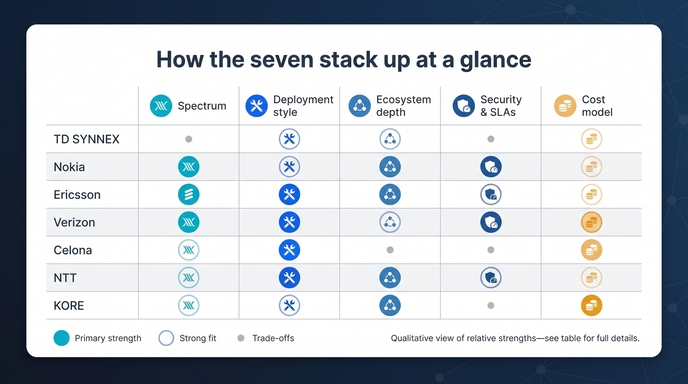
| Provider | Spectrum strengths | Deployment style | Ecosystem depth | Security and SLAs | Cost model |
| TD SYNNEX | Licensed, CBRS, unlicensed through multi-vendor lineup | Channel-led turnkey; partner installs | Broad—hundreds of hardware and SIM vendors | Depends on partner, can reach four nines | Mix of CapEx gear plus optional financing |
| Nokia | Global licensed and local licenses, CBRS ready | Vendor and integrator teamwork | 900+ enterprise customers, vast device list | Carrier-grade encryption, five nines options | Higher CapEx, proven ROI in heavy industry |
| Ericsson | Operator spectrum, CBRS, private NR-U pilots | Delivered with carriers or SIs | Cradlepoint routers, large device certification program | Dual-mode core with automated anomaly detection | Premium gear, Opex if bought via carrier |
| Verizon | Exclusive C-band and PAL, plus CBRS GAA | Fully managed service | Nokia/Ericsson radios, Verizon device catalog | 24 × 7 NOC, strict SLAs, local breakout | Subscription, zero CapEx but recurring fees |
| Celona | CBRS and emerging local 5G bands | DIY-friendly cloud onboarding | Growing, deep Aruba tie-in | Zero-trust SIM provisioning, cloud updates | All-inclusive annual subscription |
| NTT | Any band, NTT secures it for you | End-to-end managed | Multi-vendor plus NTT edge and AI services | Integrated cyber team, custom KPIs | Project based, premium for global scope |
| KORE | CBRS, LTE-M, NB-IoT, carrier roaming | Turnkey IoT focus | Strong in M2M devices and eSIM | Single portal for private and public traffic | Subscription per device or SIM |
Key patterns to note:
- If licensed spectrum and strict SLAs top your list, Verizon and Nokia land on the short list.
- Need Wi-Fi-style simplicity? Celona wins on ease, while TD SYNNEX offers one-stop aggregation.
- Multinational complexity favors NTT, and mixed IoT fleets point to KORE.
Keep these cues handy as you map requirements to vendors in your next planning session.
Buying considerations: five questions to settle before you sign
Pause before you pick a private 5G distributor. A focused discovery checklist now can save months of redesign later.
- Use case. Are you chasing reliable video from autonomous forklifts, or retiring aging DECT phones? Throughput, latency, and device density differ sharply between those goals, and those numbers drive every other decision.
- Spectrum. In the United States, CBRS often wins on speed and cost, but when interference risk is a deal-breaker, licensed C-band from a carrier may justify the premium. International sites follow local 5G rules. Confirm band support in both the radios and the end devices before ordering.
- Integration points. Private 5G rarely stands alone; it shares identity stores, VLANs, and firewalls with your existing LAN. Bring network, security, and OT teams into design sessions so SIM provisioning, QoS policies, and observability feed the tools they already trust.
- Operations. Decide who installs patches, who monitors KPIs at 2 am, and who replaces a failed radio in the rain. A turnkey service shifts that load to the vendor but commits you to ongoing Opex. A do-it-yourself approach keeps control close to home, yet adds pager duty to your team.
- Pilot. Start with one building, one critical workflow, and thirty days of metrics. Validate coverage, latency, roaming, and security logging under real traffic. A strong vendor includes the pilot in the statement of work, so insist on it before green-lighting a campus-wide rollout.
Quick-fire FAQ
Is private 5G always better than Wi-Fi 6E?
Not automatically. Wi-Fi 6E wins on cost and peak indoor throughput, while private 5G covers larger areas with fewer radios, handles mobility cleanly, and uses SIM authentication instead of shared passwords. Choose 5G for roaming robots or interference-prone factories; stick with Wi-Fi for dense offices and conference rooms.
Do we need a spectrum license?
In many regions you can use shared or lightly licensed bands such as CBRS in the United States, 3.8 GHz local licenses in Germany, or n79 in Japan. Where no local band exists, you partner with a carrier for a slice of its licensed spectrum. Plan for both the regulatory fee and the lead time to secure approval before your deployment window.
How long until we see ROI?
Early adopters report payback within twelve months when the network enables automation (for example, faster AGV routes or reduced cable maintenance). Soft gains like higher safety scores often show up sooner. Run a pilot with clear KPIs so you can compare the baseline with private 5G and build a business case rooted in data.
Conclusion
Private 5G adoption is accelerating, but success hinges on matching your use case, spectrum requirements, and operational model to the right distributor. Use the rankings, side-by-side comparisons, and buying checklist above to create a confident shortlist—and pilot early to prove the value before scaling across your enterprise.